


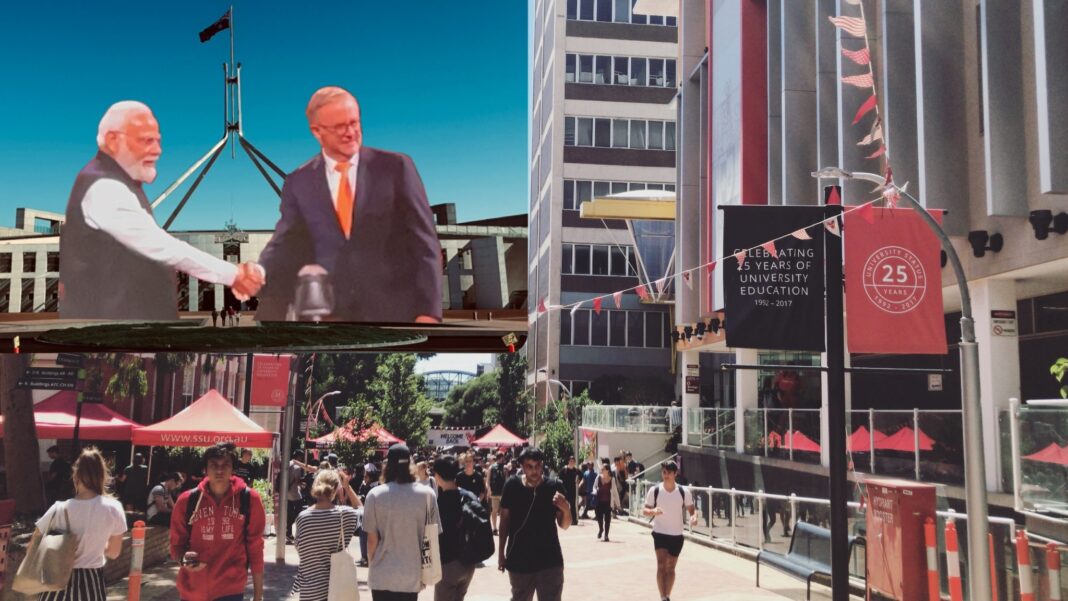
When Prime Minister Narendra Modi visited Australia in May 2023 for high-level bilateral talks, headlines were unexpectedly dominated not by trade agreements or technology partnerships, but by the sudden announcement from several Australian universities restricting admissions from specific Indian states due to alleged visa fraud concerns. It was an awkward backdrop for a visit meant to celebrate “trust and ties.”
Now, almost three years later, history seems to be repeating itself. As Indian Link reports, Modi is expected to visit Australia in July 2026. And once again, in the months just before his visit, Indian students are facing a tightening of visa processes.
According to a recent NDTV report, Australia has reverted to pre-2025 rules, moving Indian applicants to Category Level 3 — the lowest assessment tier — requiring more extensive documentation and financial proof.
The Question of Timing
The timing is hard to ignore. Each time India’s leadership prepares for high-level talks, a bureaucratic chill seems to descend on Indian students. Is this mere coincidence — or quiet negotiation through administrative pressure?
Could this be a subtle form of economic signaling, with Australia using student visa policy as leverage in drawn-out trade negotiations? Or does it reflect a deeper failure of trust in bilateral diplomacy, where unresolved trade and tariff issues spill over into the education corridor?
The Human Cost
For Indian students, these shifts are more than diplomatic theatre. They translate into uncertainty, rejections, financial stress, and suspicion — at a time when Australia claims to value educational exchange as a key pillar of the relationship. If Canberra believes education cooperation builds mutual understanding, why does it repeatedly risk alienating the very generation that sees Australia as a partner in progress?
Should Indian applicants simply accept this as the new normal? Who will speak out against what amounts to a pattern of tightening scrutiny — one that seems to intensify whenever diplomacy heats up?
The Economic Stakes
The economic cost of shutting the door, even partially, would be real and immediate. Australia’s international education sector is not a symbolic export; it is one of the country’s biggest earners. Victoria’s international education industry generated $15.9 billion in export revenue in 2024 and supported about 64,000 jobs, while South Australia’s sector reached $3.152 billion in 2023, becoming the state’s first export industry to pass the $3 billion mark. At the national level, international student fees accounted for $12.33 billion, or 27.3% of total revenue across Australian universities in 2024.
That means even a modest decline in Indian enrolments would not just affect universities; it would ripple through state economies, rental markets, service industries, and regional employment. In practical terms, the loss would be measured not only in fewer students, but in fewer jobs, weaker university budgets, and reduced export income. If India is treated as a political pressure point, Australia may end up weakening one of its most valuable long-term economic relationships.
Why This Matters
This issue matters because education is one of the few parts of the India-Australia relationship that works at scale and creates goodwill beyond politics. When student policy becomes entangled with diplomatic timing, it sends a damaging signal that trust is conditional and access can be tightened whenever negotiations become difficult.
It also matters because international education is deeply embedded in state economies.
Victoria and South Australia, in particular, have built major export value around attracting overseas students, so policy shifts that discourage Indian applicants can have consequences far beyond campus gates. What looks like a visa adjustment on paper can become a multi-billion-dollar hit in practice.
The Bigger Question
If education becomes a tool of trade leverage, it is not just students who lose — it is the credibility of the partnership itself.
References:
- NDTV April 2026: https://www.ndtv.com/education/study-abroad-australia-tightens-student-visa-documentation-for-indian-applicants-reverts-to-pre-2025-rules-11307303/amp/1
- SMH May 2023: https://www.smh.com.au/politics/federal/universities-extend-indian-student-ban-amid-visa-fraud-concerns-20230522-p5da7t.html
- BBC on Modi’s 2023 Australia visit and migration deal: https://www.bbc.com/news/world-asia-india-65692534
- Australian trade minister release on India trade deal and education: https://www.trademinister.gov.au/minister/dan-tehan/media-release/education-big-winner-in
dia-trade-deal - SBS on Australia-India migration deal: https://www.sbs.com.au/news/article/australia-and-india-have-signed-a-new-migration-deal-heres-what-we-know/3qmk7glj3
- ICEF overview of trade agreement and student benefits: https://monitor.icef.com/2023/01/major-new-trade-agreement-with-india-will-help-to-furtherboost-the-recovery-of-australias-fore/
- 2026 student visa risk/evidence level update: https://www.visahq.com/news/2026-01-08/au/australia-lifts-student-visa-evidence-level-for-india-nepal-bangladesh-and-bhutan/
- 2026 risk classification summary: https://www.visahq.com/news/2026-01-13/in/australia-reclassifies-india-as-highest-risk-student-visa-market-tougher-evidence-rule
- Victoria’s $15.9 billion (2024): https://djsir.vic.gov.au/priorities-and-initiatives/International-education-economic-and-social-value-for-victoria
- South Australia’s $3.152 billion (2023): https://studyadelaide.com/whats-happening/international-education-first-sa-export-top-3-billion
- University revenue: $12.33 billion / 27.3% (2024): https://thekoalanews.com/alan-olsen-on-international-student-revenue-2024/
- National context (bonus stats): https://www.education.gov.au/international-education-data-and-research/education-export-income-financial-year