

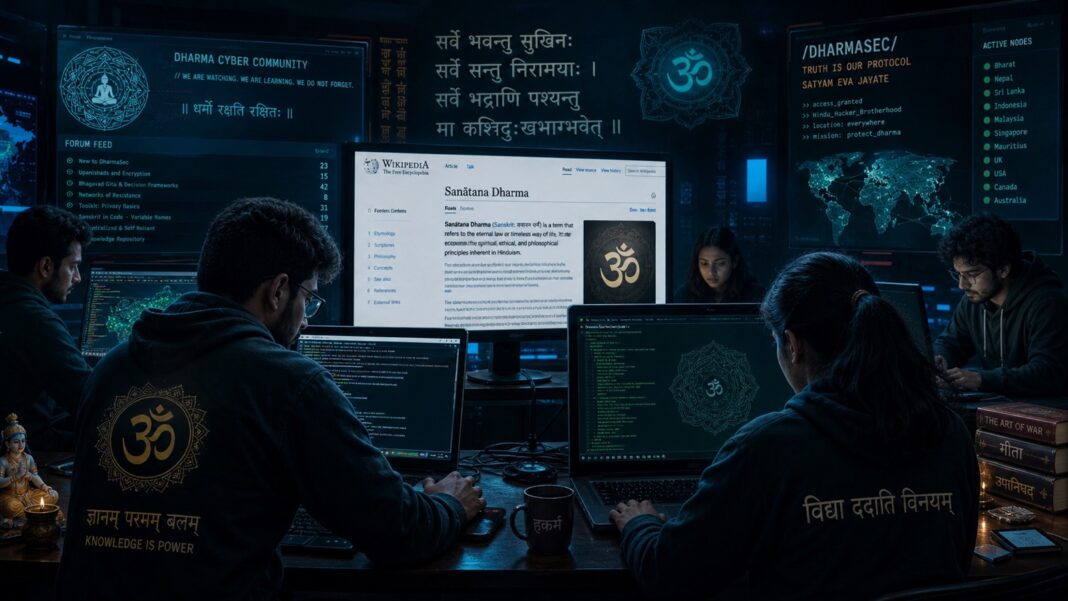
Recently a Fortune 500 company reportedly cancelled a Hindu American Foundation (HAF) (X: @HinduAmerican) training session after employees circulated its Wikipedia page. That page tells readers the HAF aligns with Hindu nationalism, threatens academic freedom, and has been accused of acting as a foreign agent. NPOV Media (X: @npovmedia) traced who built that narrative. It was revealed that the same handful of accounts kept appearing across HAF, its critics, activist groups, and key public figures—building an interconnected narrative that now feeds Google and AI systems.
The investigation found that a very small number of persistent editors—reportedly around four people—controlled the bulk of the HAF page’s content, tone, and framing. It also raised concerns about:
- Editor concentration: 80% of the page’s content was reportedly shaped by just four editors, rather than a broad, community-based editing process.
- Sourcing choices: The investigation questioned whether sources were balanced, credible, and truly neutral, or instead selectively framed to advance a particular narrative.
- Editor conflicts and connections: One editor’s disclosed connection to a lawsuit defendant was flagged, raising concerns about conflicts of interest and whether editorial decisions were influenced by external disputes.
- Editorial neutrality: The report argues that the page’s “neutral point of view” was compromised, with activist framing and selective editing shaping how the organisation is understood.
These are not minor editing disputes. This highlights a critical failure point in the Wikipedia model, one where the system assumes good faith from all participants. When that good faith is absent, and when a small group is determined to use the platform to project a specific political or social narrative, the platform’s own rules (which are intended to prevent bias) can be manipulated to enforce it. When misinformation is maintained by a small, persistent group despite valid challenges, it ceases to be a “neutral” and functions effectively as a platform for propaganda under the protection of a shield of “policy.”
When a few people dominate a page’s narrative, the result is not neutrality—it is narrative capture. And when that page is about a Hindu advocacy organisation, the impact extends far beyond one entry.
Why this matters in Australia
Australian Hindu and Indians are a rapidly growing community. And yet our public representation, and perception remains fragile. Universities, media organisations, and policymakers often rely on digital sources—especially Wikipedia—when forming first impressions of Hindu advocacy, Indian civil society, and diaspora institutions. If those sources are skewed, the consequences are real.
- A distorted or selective narrative online can reinforce stereotypes about Hindu advocacy being “extremist” or “political” rather than community based.
- It can shape how ANZAC, Australian universities, and media outlets frame Indian and Hindu voices in public debate.
- It can influence how Australian institutions treat Indian diaspora advocacy on issues like racism, religious discrimination, and policy representation.
This is not paranoia. It is structural: online reputation increasingly determines whether a community is heard as legitimate. For Australian Hindus and Indians, this is not a distant problem. “The online narratives constructed overseas increasingly feed directly into how our community is perceived in Australia”. These edited versions of the reality with much disinformation reach the desks of the politicians, law enforcement, and national security agencies.
The core issue: not neutrality, but narrative control
The investigation highlights a critical problem: when a small number of persistent editors, combined with activist framing and selective sourcing, can dominate a page’s content and tone. If accurate, this points to a deeper structural issue: neutrality becomes a label rather than a practice.
When a contested narrative is repeated often enough, it begins to look like consensus. That is how narrative capture works. The broader lesson is not that every criticism is malicious, or that every edit dispute is a conspiracy. The lesson is that standards must be applied consistently. If a page claims neutrality, it must earn that through open process, balanced evidence, and accountable editing.
Why Australian Hindus should not ignore this
The Australian Hindu and Indian community have learned, repeatedly, that representation is never just symbolic. It affects:
- Whether our institutions are heard in Australian universities and policy circles
- Whether our concerns are taken seriously in media coverage
- Whether our contributions are recognised fairly in public life
And because information ecosystems are global, campaigns overseas can quickly shape how those communities are discussed here. Case in point – Despite being amongst the best in assimilating and integrating amongst all migrants, Indians have increasingly been targeted and faced the aftermath of the anti-immigration rallies and hate campaigns.
Australian institutions should take note
Diaspora communities in this country do not exist in isolation from global information ecosystems. A campaign to shape the reputation of Hindu or Indian organisations overseas can influence how those communities are discussed here, including in media coverage, academic settings, and public debate.
The flaw of the Global Hindu and Indian Diaspora
The global internet handles Indians poorly. We ourselves are to blame for this. Colonial baggage means that unlike other highly unified diasporas/global communities who form a strict, protective circle around their identity when attacked from the outside, the Indian internet presence is profoundly & fundamentally fractured.
When a generalized, racist attack is levelled against Indians on a global platform, we tend not to respond as a singular, powerful civilizational bloc. Nearly a thousand years of invasions and colonisation has left a permanent scar and is responsible for our lack of united response. Inherently we have civilisational unity but with this systematic internal fracturing for historical reasons, we are observing the lack of proactivity against the culprits.
In the language of arthashAstra (अर्थशास्त्र) written by kautilya (कौटिल्य) this is the classic vulnerability of a state suffering from abhayAntara kopa (अभ्यान्तर कोपः = internal dissension). chaNakya (चाणक्य) explicitly warned that a massive kingdom with infinite wealth & numbers can be brought down effortlessly by a tiny external enemy if the kingdom’s internal factions hate each other more than they value their collective security.
What Australian Hindus and Indians should do: a proactive agenda
For the Australian Hindu and Indian community, vigilance is not optional. We need a proactive approach and consider the following actions.
1. Monitor key Wikipedia pages
Track pages that affect Hindu and Indian advocacy, universities, and diaspora organisations. Watch for sudden content changes, biased framing, or activist-driven edits.
2. Demand sourcing integrity
Support platforms and institutions that require transparent sources, balanced evidence, and accountability in editorial decisions. When sources are selective or ideologically loaded, challenge them publicly.
3. Build community-led documentation
Create and maintain community-owned resources: databases, fact sheets, and public-facing documentation that are accurate, sourced, and visible. This reduces reliance on platforms that can be manipulated.
4. Engage universities and media
Encourage Australian universities, media outlets, and policy bodies to verify their digital sources before citing them. Push for source transparency and balanced representation.
5. Support diaspora-led advocacy
Strengthen diaspora networks that can respond quickly to narrative attacks, misinformation, or ideological framing. This includes advocacy groups, community organisations, and religious institutions.
The bigger picture: narrative power is civic power
This is about more than one Wikipedia page. It is about who gets to define Hindu and Indian identity in public life, whose voices are treated as credible, and whether community representation is allowed to stand on equal footing with ideological activism. The Indian internet demographic needs to develop the civilizational maturity to drop internal squabbles & present a united front against external degradation, otherwise the algorithm will continue to exploit & monetize the fractures.
For the Australian Hindu community, the takeaway is clear. We cannot afford to be passive while narratives about our identities and institutions are written by others.
In an age where information itself is contested terrain: “vigilance is necessary followed by a systematic response”.
Sources
- https://www.neutralpov.com/p/wikipedias-india-war
- https://www.scmp.com/news/asia/south-asia/article/3311697/fighting-stops-india-pakistan-start narrative-war-sway-global-opinion
- https://opticsaus.org/australias-loudest-silence-when-australian-indian-hindu-voices-do-not-mat ter/
- https://www.neutralpov.com/p/wikipedias-india-war
- https://cohna.org/who-is-shaping-hindu-narratives-on-wikipedia
- https://techcrunch.com/2024/11/05/india-issues-notice-to-wikipedia-over-concerns-of-bias/
- https://www.facebook.com/TheAusToday/posts/australian-hindus-stand-up-against-abc-newss alleged-hinduphobia-and-biased-repo/7122
- https://hinducouncil.com.au/webinar-protest-against-bias-coverage-of-australian-media-on-ram janmabhumi-sunday-4th-february-8-9p
- https://journals.sagepub.com/doi/10.1177/1329878X251330792
- https://firstdraftnews.org/long-form-article/disinformation-stigma-and-chinese-diaspora-policy-gu idance-for-australia/
- https://www.facebook.com/theprintindia/posts/larry-sanger-the-founder-of-wikipedia-has-weighe d-in-on-a-fiery-debatethe-purpor/84