


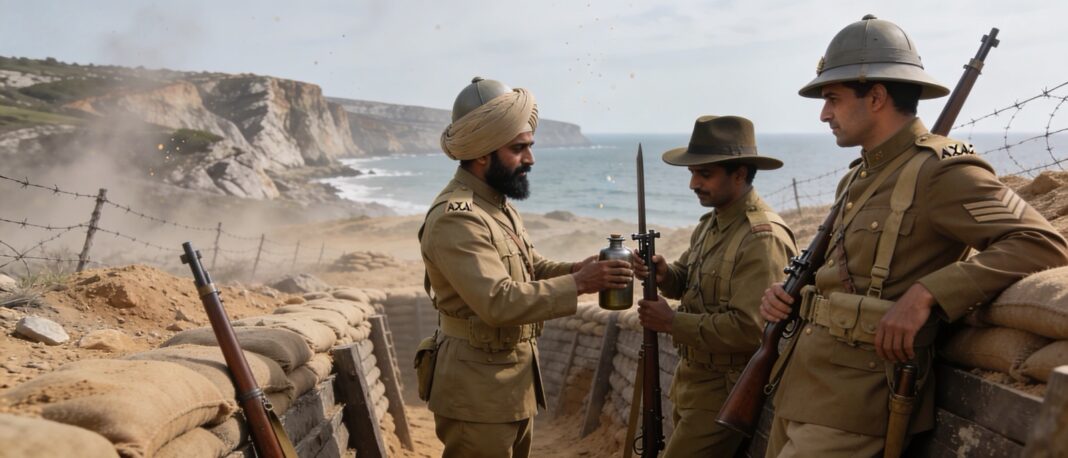
Each ANZAC Day, public remembrance returns to familiar images: the landing at Anzac Cove, Simpson and his donkey, and the spirit of mateship forged under fire. Yet this narrative often leaves out another group who also served, suffered, and died at Gallipoli: the valiant soldiers of the British Indian Army. Very few people are aware that from the opening stages of the campaign on 25 April 1915 until the evacuation in January 1916, Indian troops fought alongside Australian and New Zealand forces in some of the harshest conditions of the war. Australian historian Professor Peter Stanley from UNSW has written about the courage of Indian troops observed in his book, Die in Battle, Do Not Despair – The Indians on Gallipoli, 1915.
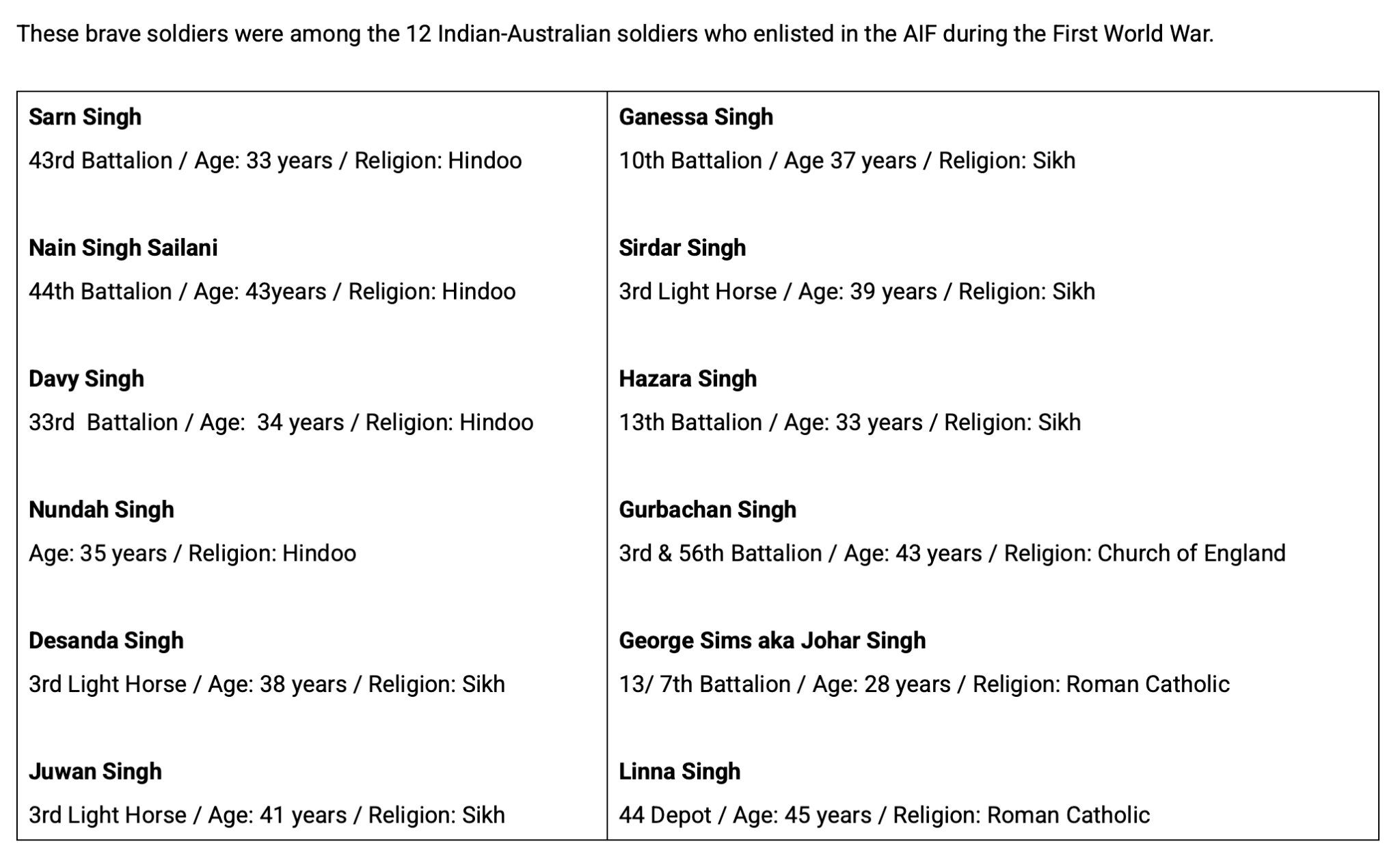
The 29th Indian Infantry Brigade saw action at Cape Helles, while the 7th Indian Mountain Artillery Brigade supported operations linked to the ANZAC sector. The Indian Mule Corps, numbering more than 4,000 men, transported ammunition, water, food, and medical supplies across steep and broken terrain where conventional transport was often impossible. Their labour was essential to the survival and effectiveness of frontline troops. An estimated total 15,000 to 16,000 Indian soldiers served in the Gallipoli campaign, 16 Australian Indians among them, with around 1,600 killed and approximately 3,500 wounded. They were involved in key engagements, including Gurkha Bluff, Krithia, and the August Offensive. These men were not on the margins of the story. They were not incidental to the campaign, rather they helped sustain it. They were part of its centre.
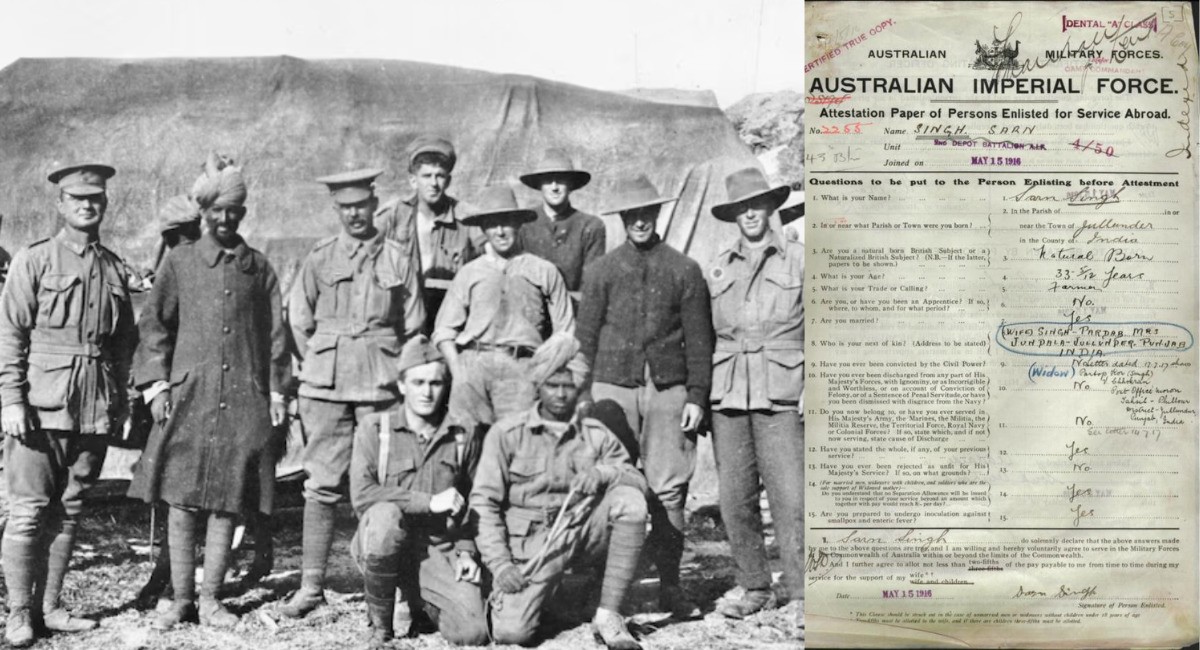
Image: (Left) Indian soldiers in World War I; Image credit:Crystal Jordan Australian Indian Historical Society Inc. 2013; (Right) Service Record for Private Sarn Singh. Image credit: National Archives of Australia.
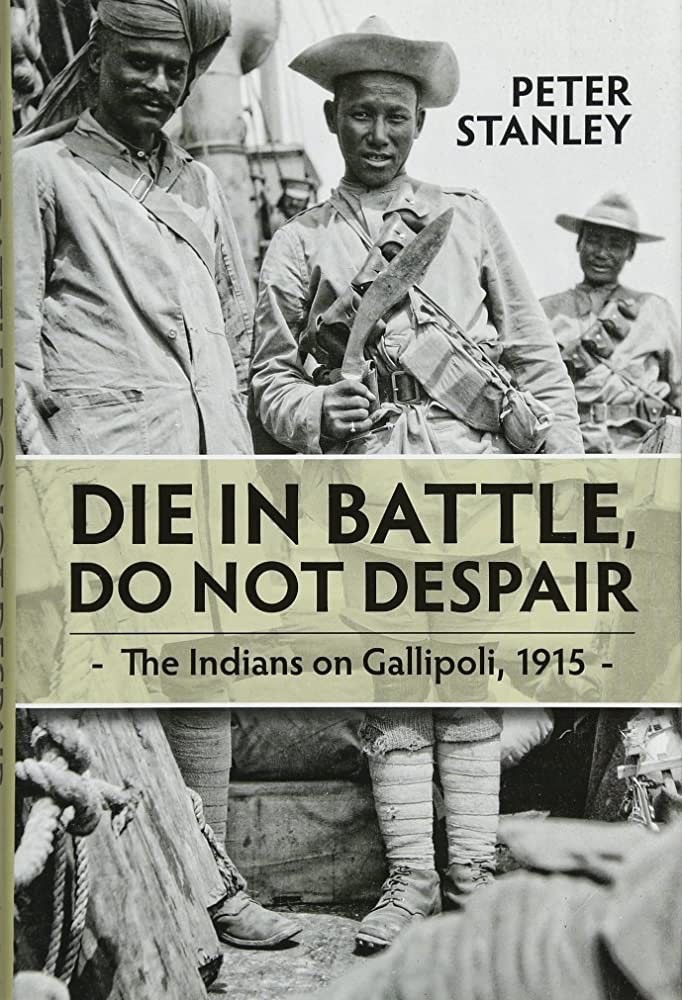 (https://shop.awm.gov.au/products/die-in-battle-do-not-despair-stanley)
Forgotten memories
Despite this, their place in ANZAC memory has remained limited. Over time, ANZAC commemoration became central to Australian and New Zealand national identity, and its public narrative narrowed accordingly. In that process, the contributions of colonial troops, including Indians, were often overlooked through habit, selective emphasis, and historical inertia.
A broader question also deserves attention: how are these sacrifices remembered in India itself? If Gallipoli has not occupied a prominent place in the Indian public memory, that too may help explain why this shared history has not received sustained recognition internationally. This is not an argument against greater acknowledgment in Australia. Rather, it highlights that remembrance is often shaped across multiple national contexts. Also, it is important to explore and understand the reasons behind the relegation of memories of this important event and the forces behind it.
It is also worth considering why this history has gained greater visibility among Indian Australian communities in recent decades. Migration may have created new opportunities for rediscovering the role of Indian soldiers within a commemorative culture where ANZAC traditions remain highly visible. If so, that development should be seen as an opportunity to enrich, rather than challenge, established remembrance practices.
Global Commemorations
The Indian Embassy and Consulate in Türkiye now hold formal Gallipoli-related commemorations, including wreath-laying at the Haydarpaşa Memorial Cemetery in Istanbul, specifically honouring Indian soldiers who served and died in the campaign.
In 2018, the ANZAC Jawan Cenotaph was unveiled in Cherrybrook, NSW, as a community-led memorial that honours Australian soldiers of Indian heritage and acknowledges the wider group of Indian troops who fought alongside the ANZACs, including at Gallipoli. The cenotaph is not an Indian or British government project, but it has been supported and recognised in broader commemorative discourse in Australia as part of addressing the “forgotten” Indian dimension of ANZAC history. Indian veterans and community groups in Australia have also taken their own initiatives, such as attending ANZAC Day services and organising tributes to Indian soldiers; they note that participation is often self-initiated, with occasional logistical support from the Indian government but not as a formal state-led Gallipoli contingent.
British and Commonwealth educational and heritage organisations increasingly mention the role of Indian troops at Gallipoli in online resources and talks, but this usually appears as part of broader “Empire at war” framing rather than as a major standalone emphasis.
The most constructive path forward is inclusion through respect. This could involve incorporating Indian units more fully into official narratives, strengthening school-based education about the multinational nature of the Gallipoli campaign, supporting joint commemorative events, and encouraging participation in ANZAC marches in ways that honour the solemn purpose of the day.
Such recognition would not diminish ANZAC Day. It would deepen it. Gallipoli was not solely an Australian and New Zealand story, but part of a wider imperial and multinational campaign in which many served side-by-side under extraordinary conditions.
A fuller remembrance of Gallipoli should acknowledge all who contributed to that ordeal. Recognising Indian soldiers does not divide historical memory; it makes it more complete, more honest, and more worthy of the sacrifices it seeks to honour.
Lest we forget them too.
References
- https://shop.awm.gov.au/products/die-in-battle-do-not-despair-stanley
- https://www.theaustraliatoday.com.au/do-you-know-two-hindu-indian-australian-anzac-soldiers-made-the-first-supreme-sacrifice-106-years-ago/
- https://www.abc.net.au/news/2015-04-22/indias-forgotten-soldiers-who-fought-alongside-anzacs/640608
- https://militaryshop.com.au/our-blog/indias-forgotten-soldiers-who-fought-alongside-the-anzacs
- https://historyandheritage.cityofparramatta.nsw.gov.au/blog/2015/04/07/the-indian-mountain-battery-and-mule-corps-gallipoli-1915
- https://www.newzzit.com/stories/the-forgotten-history-of-indians-at-gallipoli-yes-almost-1400-were-killed-there
- https://www.india1914.com/gallipoli.aspx
- https://www.coloursofglory.org/indian-army-gallipoli-1915/
- https://www.awm.gov.au/articles/blog/remembering-sikhs
- https://www.cgiistanbul.gov.in/section/press-releases/aacommemoration-of-the-participation-of-indian-soldiers-in-the-gallipoli-campaign-on-the-occasion-of-the-78th-indian-army-day/
- https://www.sbs.com.au/language/hindi/en/podcast-episode/lest-we-forget-saluting-indian-soldiers-who-fought-with-anzac-forces-in-gallipoli/307iqld5s
- https://www.gallipoli-association.org/education/about-gallipoli/the-world-at-war/