


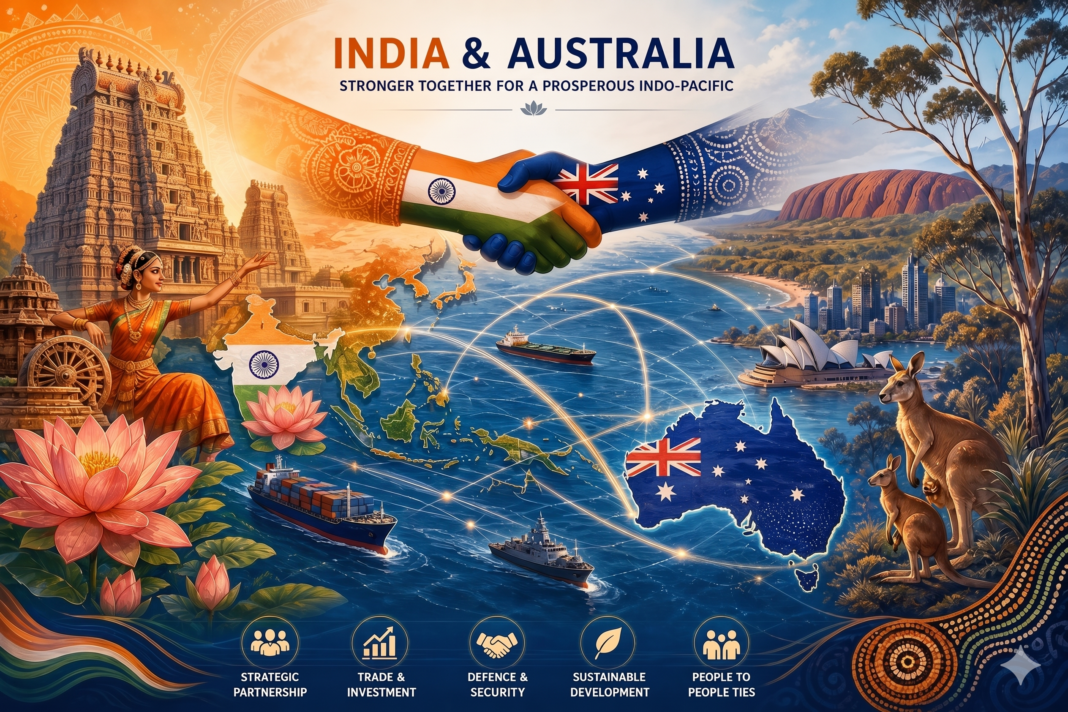
How a Decade of Friendship Became a Strategic Partnership for the 21st Century
Over the past decade, Australia and India have transformed their relationship from a cordial partnership into one of the most consequential bilateral relationships in the Indo-Pacific. What was once defined primarily by trade, education, migration, and cricket has evolved into a comprehensive strategic partnership encompassing defence cooperation, critical minerals, clean energy, civil nuclear collaboration, advanced research, and a shared vision for regional stability.
Today, Australia and India are not merely partners of convenience. They are increasingly aligned nations bound by common democratic values, complementary economic strengths, and a growing commitment to shaping a free, open, and prosperous Indo-Pacific.
As Australian Prime Minister Anthony Albanese observed, “The relationship between Australia and India has never been stronger.” That sentiment is echoed in New Delhi, where Prime Minister Narendra Modi has repeatedly described the Australia–India friendship as, “a partnership of enduring strategic importance and mutual trust.”
Challenges to the Rules-Based Order in the Indo-Pacific
The Australia–India partnership has deepened against a backdrop of mounting pressure on the rules-based order in the Indo-Pacific. Both governments increasingly frame their cooperation as a response to regional instability and coercive behaviour.
Key challenges include
- Maritime coercion and territorial disputes
Competing claims in the South China Sea and growing militarisation of contested waters have raised concerns about freedom of navigation and adherence to international law, including the United Nations Convention on the Law of the Sea (UNCLOS).
- Grey-zone activities
States increasingly employ cyber operations, economic coercion, disinformation, and maritime militia tactics that fall below the threshold of conventional conflict but undermine regional stability and sovereignty.
- Supply-chain vulnerability
Dependence on concentrated suppliers for critical minerals, semiconductors, and energy technologies has exposed Indo-Pacific economies to strategic and economic shocks. This has driven Australia and India to prioritise resilient supply chains and trusted partnerships.
- Climate and energy insecurity
Climate change is intensifying natural disasters, threatening coastal infrastructure, and increasing competition over resources and energy transitions. Both countries now view climate resilience and clean energy cooperation as strategic imperatives, not merely environmental goals.
- Erosion of multilateral norms
Institutions designed to manage regional disputes and uphold international law face growing strain from power politics and unilateral actions. Australia and India have consistently argued that middle powers must play a larger role in defending multilateralism and regional rules.
In this context, the Australia–India partnership is increasingly seen as part of a broader effort to reinforce a stable regional architecture where sovereignty is respected, disputes are managed peacefully, and economic growth is not held hostage to coercion.
A Shared Vision for the Indo-Pacific
Australia and India occupy pivotal positions across the Indo-Pacific. Together, they span the eastern and western reaches of the Indian Ocean and serve as key democratic anchors in the region. Their cooperation extends beyond bilateral interests. Both nations are active members of the Quad alongside the United States and Japan, supporting initiatives focused on maritime security, resilient supply chains, critical technologies, and regional development.
This shared strategic outlook has strengthened defence cooperation significantly over the past decade. Joint naval exercises, maritime domain awareness initiatives, intelligence exchanges, and defence dialogues have become routine features of the bilateral relationship. As Foreign Minister Penny Wong noted, Australia and India “share a region and share a future”, a phrase that increasingly captures the strategic reality facing both countries.
From Friendship to Strategic Partnership
A defining moment in the relationship came in 2020 with the establishment of the Australia–India Comprehensive Strategic Partnership (CSP). The agreement marked a significant shift in bilateral engagement, elevating cooperation beyond traditional trade and diplomatic ties into a structured framework for long-term collaboration.
The CSP created new mechanisms for annual leaders’ summits, regular foreign and defence minister consultations, and expanded cooperation across maritime security, technology, climate action, and economic development.
More importantly, it reflected a growing convergence in how both nations view the future of the Indo-Pacific. Australia and India share a commitment to sovereignty, regional stability, freedom of navigation, and a rules-based international order—principles that have become increasingly important in a rapidly changing strategic environment.
Building a Modern Economic Partnership
Economic ties have expanded rapidly as both governments seek to unlock the complementary strengths of their economies.
The Australia–India Economic Cooperation and Trade Agreement (ECTA), which entered into force in 2022, represented the most significant trade liberalisation initiative in the history of the relationship. The agreement reduced tariffs, improved market access, and created new opportunities across manufacturing, services, agriculture, technology, and investment.
With India projected to become one of the world’s largest economies in the coming decades, Australian businesses are increasingly viewing the country as a critical long-term market. At the same time, India sees Australia as a reliable supplier of resources, energy, education, and technological expertise.
Particularly important is cooperation in critical minerals. Australia’s reserves of lithium, cobalt, nickel, and rare earth elements complement India’s ambitions to expand manufacturing capacity and accelerate its clean energy transition. Joint initiatives in green steel, renewable hydrogen, battery technologies, and supply-chain resilience are rapidly becoming central pillars of the economic relationship.
Civil Nuclear Cooperation and Energy Security
One of the most significant demonstrations of trust between the two countries has been civil nuclear cooperation. The Australia–India Nuclear Cooperation Agreement enabled the export of Australian uranium for peaceful civilian purposes under strict international safeguards. Beyond its commercial value, the agreement signalled a deeper level of strategic confidence between Canberra and New Delhi.
For Australia, it recognised India’s growing role in global energy security and climate solutions. For India, it provided access to reliable fuel supplies necessary to support long-term economic growth while reducing carbon emissions.
The agreement remains an important symbol of how the relationship has matured from transactional engagement to strategic partnership.
Education: The Foundation of Long-Term Partnership
Few areas better illustrate the depth of Australia–India relations than education. For decades, Indian students have been among the largest international student communities in Australia, contributing significantly to academic institutions, research capacity, and cultural diversity. Today, however, the relationship extends far beyond student mobility.
Australian universities are increasingly establishing physical campuses and long-term partnerships within India. Institutions including UNSW, the University of Western Australia, Victoria University, Deakin University, Monash University, and others are helping build a new era of educational collaboration.
Research partnerships now span emerging fields such as quantum computing, renewable energy, artificial intelligence, biotechnology, and medical science. Programs such as the Maitri Initiative and the Australia India Education and Skills Council are creating lasting networks between researchers, policymakers, entrepreneurs, and future leaders.
These investments in knowledge and human capital may ultimately prove as strategically important as defence or trade.
Cricket, Culture and the Human Connection
No discussion of Australia–India relations would be complete without cricket.
The Border–Gavaskar Trophy has evolved into one of the sport’s most celebrated rivalries, captivating audiences across both nations. Yet cricket’s significance extends far beyond the boundary rope. It has become a powerful form of cultural diplomacy, creating connections that transcend politics and geography.
Australian players competing in the Indian Premier League, shared sporting initiatives, and government-supported sports cooperation programs have strengthened people-to-people links and deepened mutual understanding.
Prime Minister Modi once remarked that the relationship between Australia and India was traditionally defined by the “3 Cs”— Commonwealth, Cricket and Curry. Today, he argues, it is increasingly characterised by “Democracy, Diaspora and Dosti” (friendship), alongside Energy, Economy and Education.
That evolution reflects the broader transformation of the partnership itself.
The Role of the Indian Diaspora
The Indian diaspora has become one of the most important bridges between the two countries.
The Australian Indians form an important part of a robust economy and add value to the business environment in Australia. As one of Australia’s fastest growing and most influential communities, Australians of Indian origin contribute across business, healthcare, education, science, technology, public service, and culture. Their success has enriched Australia’s multicultural society while strengthening connections with India.
The diaspora’s role extends beyond economics. The diaspora fosters understanding, creates business networks, encourages educational collaboration, and serves as a living embodiment of the relationship’s people-to-people foundations. They maintain one of the highest tax-paying status, whilst being the most law-abiding residents with one of the lowest dependencies on the government welfare schemes which are funded by the taxpayers.
Increasingly, leaders on both sides recognise the diaspora as a strategic asset and a cornerstone of future cooperation.
A Partnership for the Century Ahead
The story of Australia and India over the past decade is ultimately a story of convergence. Shared democratic values, expanding economic ties, educational integration, defence cooperation, energy collaboration, and deep cultural connections have combined to create one of the Indo-Pacific’s most dynamic partnerships.
The architecture is now firmly in place. Strategic trust is growing. Economic opportunities are expanding. People-to-people connections are stronger than ever. From university campuses and research laboratories to cricket stadiums, trade corridors, and naval exercises, Australia and India are building a partnership defined not only by shared interests but by a shared horizon.
As India continues its rise as a global economic and strategic power, and as Australia deepens its engagement across the Indo-Pacific, both nations are increasingly discovering that their futures are intertwined.
The coming decade may well determine how influential that partnership becomes—but the foundations have already been laid for one of the most important relationships in the Indo-Pacific century.
References
- Australian Government, Department of Foreign Affairs and Trade (DFAT), Australia–India Comprehensive Strategic Partnership and Joint Statements.
- Prime Minister of Australia, official transcripts and media releases, 2023–2026.
- Prime Minister of India, official statements and speeches, 2023–2026.
- DFAT, “Australia–India Economic Cooperation and Trade Agreement (ECTA).”
- Australian Government, “Joint Declaration on a Shared Vision for Maritime Cooperation in the Indo-Pacific,” 2020.
- Quad Leaders’ Joint Statements and Fact Sheets, 2021–2025.
- Australian and Indian Ministry of Defence announcements on bilateral exercises and maritime cooperation.
- United Nations Convention on the Law of the Sea (UNCLOS) and related regional security analyses.
- Australian Government initiatives on critical minerals, green steel, and renewable hydrogen cooperation with India.
- Joint Statement of the 2nd India–Australia Annual Summit, Rio de Janeiro, November 2024.
- DFAT trade and investment resources on Australia–India economic relations.
- Australia–India Nuclear Cooperation Agreement documentation and IAEA safeguards framework.
- Australian Safeguards and Non-Proliferation Office (ASNO), India safeguards arrangements.
- University announcements from UNSW, Monash, UWA, Deakin, Victoria University, and other Australian institutions establishing partnerships or campuses in India.
- Australia India Education and Skills Council and Maitri Initiative program materials.
- Government statements on the Australia–India sports cooperation MoU, 2023.
- Border–Gavaskar Trophy historical coverage and IPL participation records.
- Australian Bureau of Statistics and government commentary on the Indian-Australian diaspora.