

yoga (योग) has gained immense popularity in Australia and around the world. There are approximately 2,540 registered yoga studio operations in Australia [IBISWorld, 2025]. The ancient Hindu science of self-realisation has arrived in Australia on a large scale, yet much has been lost in transit. Hence, beer yoga, goat yoga, dog yoga – anything to make a buck. While there have been many respectful traditional and contemporary adaptations of Yoga highlighting its versatility, selective appropriation and insufficient government recognition prompts reflection on how we preserve its deeper essence in Australia.
For the Australian Hindus and the broader Australian Indian diaspora living in Australia, this transformation is not merely a philosophical debate. It cuts to the heart of identity, spiritual dignity, and cultural survival in a country they now call home.
yoga is a greater than 5,000-Year-old practice from India
yoga’s roots reach back to over 5,000 years in the sindhu-sarasvati civilisation (also known as Indus Valley Civilisation, IVC) of northern India. Seals of pashupati (पशुपति = a form of Shiva depicted in a yogic pose), and dated to be over 12000 years old, have been found during excavations at Mohenjo-daro in the Indus valley.
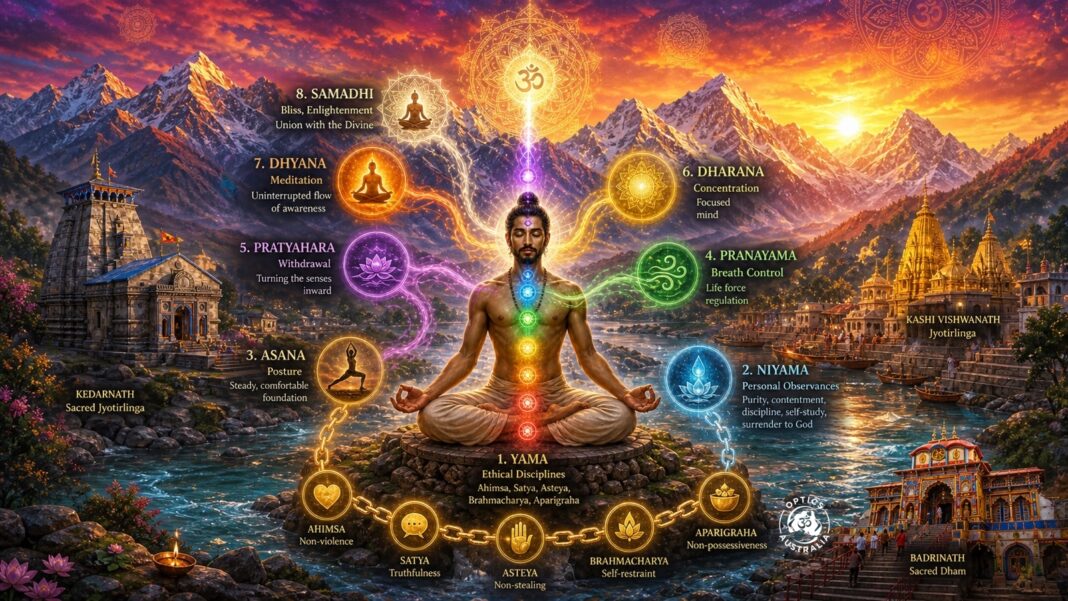
Yoga is one of the six classical Hindu philosophical systems of the Vedic civilisation, closely associated with the sAMkhya (सांख्य) philosophy. The word ‘yoga’ originates from the Sanskrit root verb yuj (युज्) — to unite. Its goal is the union of individual consciousness with the all-pervading supreme consciousness. Rishi patanjali’s yoga sUtras define the eight-fold path aSTAGga yoga (अष्टाङ्ग योग): yama (यम = social ethics), niyama (नियम = personal discipline), Asana (आसन = posture), prANAyAma (प्राणायाम = breath and vital energy), pratyAhAra (प्रत्याहार = withdrawal of the senses), dhAraNA (धारणा = concentration), dhyAna (ध्यान = meditation), and samAdhi (समाधि = enlightenment). The phrase in the ancient text of mahopaniSada (महोपनिषद) (5.42) –मनः प्रशमन उपायः योग इत्यभिधीयते– “(manah prashamanah upAyah yoga ityabhidhIyate)” translates as “yoga is the skilful method to calm the mind”. It highlights that yoga is not about brute force over thoughts, but a subtle, skilful process for bringing a disturbed mind to a natural state of peace.
However, what we see today in the various Yoga studios is, that rich tradition has largely been reduced to a 45-minute stretch class. On the websites and Instagram feeds of most studios, there is no mention of India or the Hindu philosophy that gave birth to the practice. Worse still, some voices on social media actively spread misinformation, falsely labelling yoga as a form of demon worship — a distortion that compounds the original harm.
Two Faces of Appropriation
The problem is not that non-Hindus practise yoga, since by its own philosophy, it is a universal gift that invites all of humanity to benefit from its wisdom. The problem is erasure and distortion — and it operates on two fronts.
The first is commercial erasure.
The deliberate omission of Yoga’s Indian and Hindu origins to make the practice commercially palatable to non-Indian consumers, while simultaneously using Hindu imagery and vocabulary — OM symbols on activewear, deity figures on yoga mats, tAntrika (तान्त्रिक) retreats with no understanding of tantra (तन्त्र) — stripped entirely of their meaning and purpose.
The second is reductive flattening of yoga to mere physical exercise.
According to gheranDa saMhitA (घेरन्ड संहिता) and the haTha yoga pradIpikA (हठ योग प्रदीपिका), foundational texts of the nAtha tradition (नाथ परम्परा), the haTha yoga (हठ योग) path encompasses AsanAs, prANAyAma, pratyAhAra, dhAraNA, dhyAna, and samAdhi. Asanas themselves are not designed for physical fitness; their primary purpose is to provide steadiness (sthiratA = स्थिरता), lightness (angallAghava = अन्गल्लाघव), and health (Arogya = आरोग्य) as a foundation for deeper spiritual practice, not as an endpoint.
For members of Australia’s Hindu community, these distortions are not trivial aesthetic grievances. It is the experience of watching a living tradition be hollowed out and repurposed for commercial gain. The sacred syllable Om, understood in Hindu tradition as the primordial sound signifying ultimate reality, now appears on leggings, tattoos and car decals, almost always divorced entirely from its meaning.
When yoga is taught and marketed exclusively as a fitness modality, its most transformative dimensions — ethical living through the yama and niyama, contemplative practices of pratyahara and dharana, and the ultimate pursuit of self-realisation — are discarded entirely. What remains is, at best, effective stretching. At worst, the sacred is trivialised.
Different approaches to different traditions
There is a marked difference in Australian Government’s approach to and treatment of Traditional Chinese Medicine (TCM) and yoga.
- TCM is a nationally registered health profession, regulated under AHPRA, attracts Medicare and private health insurance rebates and embedded in regulated health‑workforce planning and quality/safety frameworks.
- yoga, despite a large and growing body of evidence regarding practitioner benefits for those of all ages, does not yet enjoy the benefit of recognition. There is no Australian government regulator for yoga comparable to AHPRA; yoga is not a nationally registered health profession, and there is no protected “yoga teacher” or “yoga therapist” title in law. As a result, standards and quality control are set by private associations and training providers rather than legislation or statutory boards. [8]
- Despite yoga being an evidence‑informed modality for health and wellbeing, including for, but not limited to, conditions like low back pain, anxiety and depression, a yoga instructor is treated on par with a Pilates instructor under the Sports and Fitness Workers group in the national occupational classification framework (OSCA, formerly ANZSCO) [9]
On the other hand, India has enabled formal education in yoga by establishing centralized universities (e.g., SVYASA, Uttarakhand Sanskrit University), standardizing curricula through the Yoga Certification Board (YCB) under the Ministry of Ayush and integrating the 5.5-year Bachelor of Naturopathy and Yogic Sciences (BNYS) into mainstream medical education.
The Voice of the Australian Hindu Diaspora Is Missing from the Room
Perhaps most concerning is who is not at the table. Australian yoga teacher training programs and studio leadership remain largely non-Hindu. When Australian Hindu teachers seek to establish authentic, philosophy-grounded yoga classes, they find little institutional support. When they raise concerns about the misrepresentation of their tradition, they are often dismissed, sidelined, or, at best, invited as token panellists at diversity events without meaningful influence over curriculum or business practice.
The Hindu Council of Australia (HCA) has consistently advocated for the preservation of Indian cultural and spiritual traditions within the broader community [HCA, 2025]. Organisations like HCA rightly push back against the notion that yoga can simply be separated from its dhArmic roots, not just to Hindus, but to the integrity of the practice itself.
While organisations like the Hindu Council of Australia (HCA) may voice concerns, this is not solely an HCA issue, nor is it exclusively India’s challenge. Indian Prime Minister Mr. Narendra Modi’s initiative to establish International Yoga Day has successfully brought the practice to a worldwide stage. However, yoga’s roots include profound spiritual dimensions intertwined with Ayurveda and Indian philosophical traditions. These elements deserve respectful recognition rather than imposition on those from other backgrounds.
Actions by the Australian Governments for yoga
The NSW Government’s recent commitment to fund a Hindu Cultural and Education Centre in Parramatta, which will include yoga as part of an authentically Hindu cultural framework [NSW Government, 2024], represents a meaningful step. But in an industry worth billions of dollars, such initiatives remain marginal without broader structural change.
Australia has formalised yoga into a recognized professional and clinical therapy. National peak bodies like Yoga Australia and AUSactive set standardized educational requirements, while the Federal Government’s National Health and Medical Research Council (NHMRC) has validated yoga as an evidence-based intervention.
This is a good start, but there is a long way to go to establish and formalise yoga as a mainstream therapy and regulate various practitioners and businesses.
What Respectful Practice Looks Like
The answer is not to restrict yoga to Hindus alone. yoga, properly understood, welcomes the world. But welcome must be reciprocal — and it must be honest. There are several concrete steps Australian yoga studios, professional bodies, teachers, and practitioners can take:
- Acknowledge yoga’s origins openly. Naming India and Hinduism as the source of this practice is factual, respectful and honest. This acknowledgement should appear consistently in teacher training curricula, studio materials, and class introductions. The prevailing alternative is plagiarism and theft.
- Recognise and fairly compensate Indian Hindu teachers. Those who carry lineage-based knowledge should not be reduced to token appearances. Critically, professional bodies such as Yoga Australia and Yoga Alliance should formally recognise qualifications conferred by India’s Yoga Certification Board under the Ministry of Health and formally recognise yoga teachers as a nationally recognised health profession.
- Retire the commodified use of sacred symbols. Om is not a design motif. Deities are not legging prints. Sanskrit is not aesthetic branding. These elements deserve to be used with the gravity and understanding they carry.
- Engage with the broader philosophy. A yoga education that ignores the yoga sUtrAs of patanjali, yoga vAshiShTha, the bhagavad gItA, or the ethical framework of the yama and niyama is incomplete.
The Deeper Irony
There is a profound irony at the centre of all this. The qualities Australian practitioners most value in yoga, reduced stress and anxiety, a sense of inner peace amid a chaotic world, mental resilience and clarity are precisely the outcomes that the original, complete philosophy was designed to cultivate. The commercial yoga industry has erased the very roots that produce the fruits it markets.
For Australia’s Hindu and Indian community, the invitation is not to restrict yoga, but to insist on its integrity. The Vedic tradition has always been generous. Generosity, however, does not mean acquiescence to erasure. Yoga is India’s gift to humanity and like any gift, it deserves to be received with knowledge, gratitude, and respect for the hands that offered it. Importantly, many Hindus themselves acknowledge gaps in fully understanding or practising these connections. Some practitioners travel to India for short training programs before teaching abroad, which can be a positive step when approached with sincerity.
The core question remains: how much of yoga’s authentic spirit do we preserve and practise ourselves, regardless of where we live? In Australian society, as in any multicultural context, we can celebrate yoga’s universal benefits for health and wellbeing while honouring its cultural and spiritual origins with care and appreciation. This International Yoga Day offers a valuable opportunity for all of us, practitioners and enthusiasts alike, to deepen our engagement with yoga in a way that is both inclusive and respectful.
Wishing everyone a meaningful and reflective International Yoga Day!
References
[1] Australian Bureau of Statistics. (2021). Census of Population and Housing. https://www.abs.gov.au
[2] IBISWorld. (2025). Number of Businesses: Pilates and Yoga Studios, Australia. https://www.ibisworld.com/australia/number-of-businesses/pilates-and-yoga-studios/4198/
[3] IMARC Group. (2025). Australia Pilates & Yoga Studios Market Report. https://www.imarcgroup.com/australia-pilates-yoga-studios-market
[4] Wellness Creatives. (2025). Yoga Industry Statistics, Market Size & Trends 2025. https://www.wellnesscreatives.com/yoga-industry-trends/
[5] Hindu Council of Australia. (2025). Community Engagement and Cultural Advocacy. https://hinducouncil.com.au
[6] NSW Government. (2024). Hindu Cultural Centre announcement, Parramatta. https://nsw.gov.au
[7] Deshpande, R. (cited in The Oxford Student, 2020). Yoga and Cultural Appropriation. https://www.oxfordstudent.com/2020/07/11/breathing-deep-and-diving-in-yoga-and-cultural-appropriation/
[8] SBS Hindi, (2024) https://www.sbs.com.au/language/hindi/en/podcast-episode/indian-delegation-calls-for-medicare-cover-for-yoga-as-australias-parliament-celebrates-international-yoga-day/63uyg0yuw
[9] AusActive, Australia Bureau of Statistics broadens Occupation Standard Classification for Australia to include Pilates and Yoga Instructors, https://ausactive.org.au/news/pilates__yoga_now_osca_recognised/
[10] Government of India, Ministry of Ayurveda, Yoga & Naturopathy, Unani, Siddha and Homoeopathy https://sansad.in/getfile/loksabhaquestions/annex/10/as152.pdf?source=pqals
| Dimension | Yoga in Australia | Traditional Chinese Medicine in Australia |
| National profession registration | Not nationally registered; yoga teachers/therapists are not AHPRA‑regulated | Chinese medicine is a nationally registered health profession under AHPRA |
| Profession category | Treated as a natural/complementary therapy or health‑improvement | Recognised clinical health profession (acupuncture, Chinese herbal medicine) |
| Medicare – specific items | No Medicare Benefits Schedule (MBS) items for yoga or yoga therapy. | Acupuncture can attract a Medicare rebate when done by a medical practitioner under usual consult items. |
| Medicare – practical access | At most indirect inclusion in GP care plans as generic “exercise/health programs”. | Partial access when acupuncture is integrated into GP/specialist consults; |
| Private health insurance – extras | Removed from rebate‑eligible extras in 2019; now allowed again as a natural therapy from 2025, with coverage at insurer discretion. | Continuous extras cover for acupuncture/Chinese herbal medicine with recognised providers. |
| Govt rebate on PHI premiums | Only newly re‑eligible for inclusion; benefits often tied to “health management” programs and specific conditions. | Included as standard extras attracting the Australian Government Rebate on premiums. |
| Regulation of associated products | No specific therapeutic product regulation; governed mainly by general consumer and safety law. | Chinese herbal medicines regulated as therapeutic goods by the TGA (quality, safety, claims). |
| Role in government health strategy | Positioned mainly in wellbeing/preventive health promotions; advocacy is pushing for more formal recognition. | Embedded in regulated health‑workforce planning and quality/safety frameworks |