


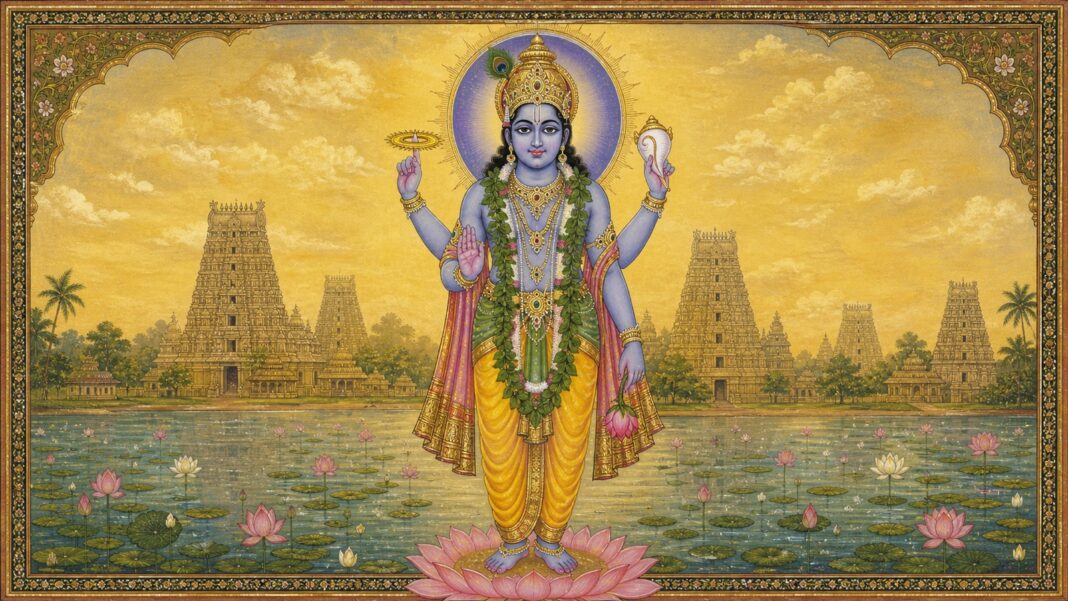
Adhika mAsa is an important occurrence in the Hindu calendar, and it shows how traditional calendrical science integrates precise astronomical calculation with spiritual meaning. Based on the lunar-solar calendar, it is an intercalary month added to realign time with the solar year, preserving the harmony of seasonal and ritual cycles. Yet its significance extends beyond mathematics. Historically regarded as an inauspicious period for worldly milestones, it was later transformed through the lore of Lord Vishnu into Purushottama mAsa, a sacred time dedicated to inner growth. This shift gave Adhika mAsa a distinct spiritual purpose, emphasizing self-reflection, meditation, charity, fasting, and chanting. In this way, the month became a protected space for purification and renewal rather than external celebration.
Adhika mAsa in 2026 began from Saturday, May 17 and will occur through Sunday, June 15. The last Adhika mAsa was in 2023, and the next will arrive in 2029.
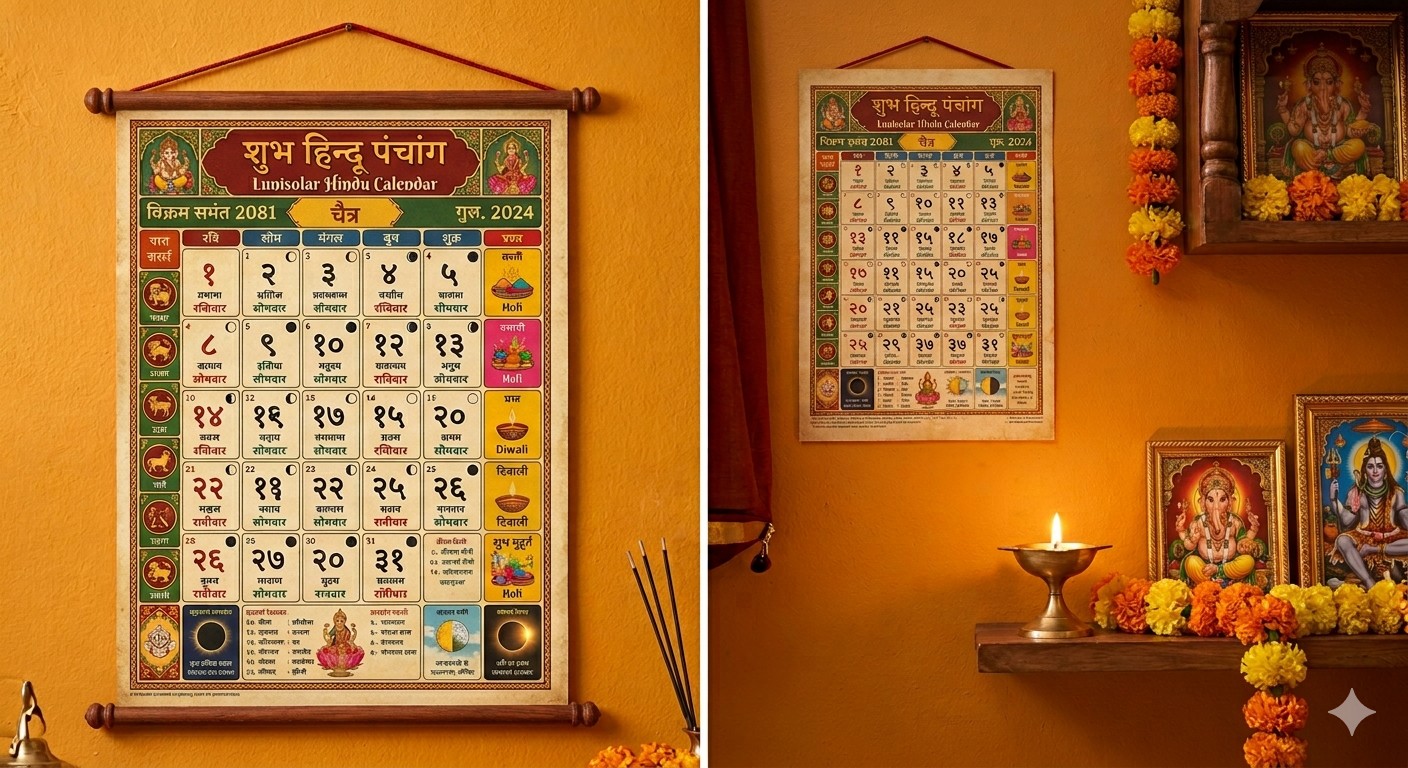
Image generated using Gemini AI
Adhika mAsa
Every few years, the Hindu calendar throws a delightful curveball: a year with thirteen months instead of twelve. This extra month is known as adhika mAsa (अधिक मास = extra month). Far from being an arbitrary quirk, it is a masterclass in ancient astronomy, mathematics, and spiritual philosophy. Also referred to as purushottama mAsa or mala mAsa, this intercalary month occurs approximately every 32.5 months, serving as a sophisticated bridge that perfectly aligns human timekeeping with the cosmos.
The Cosmic Disconnect: Solar vs. Lunar Years
To appreciate the scientific accuracy of Adhika Maasa, one must understand the two celestial cycles that govern our planet:
- The Solar Year: Dictated by the Earth’s orbit around the Sun, lasting roughly 365.24 days. This governs the natural cycle of seasons.
- The Lunar Year: Based on twelve synodic lunar months (from one new moon to the next), totalling roughly 354.36 days.
This leaves an annual discrepancy of about 11 days between the solar and lunar cycles. If left uncorrected, a purely lunar calendar would rapidly drift out of sync with the seasons. Festivals like Holi (spring) or Diwali (autumn) would retrogress through the seasons over the decades.
The Wisdom of the Surya SiddhAnta
Ancient Indian astronomers solved this planetary puzzle thousands of years ago. The definitive blueprint for this synchronization is found in the Surya SiddhAnta (सूर्य सिद्धान्त), one of the foundational treatises of Vedic astronomy. The dating of this seminal work is not confirmed yet with research by some authors claiming it to be written over 16000 years ago.
The Surya SiddhAnta provided the astronomical basis for the Hindu calendar, known as the panchAnga (पञ्चाङ्ग = five limbs), which is still used today to determine auspicious dates for religious and social events.
The Calendar System (PanchAnga)
The PanchAnga’s calculations, based on the positions of the Sun, Moon, and planets, are integral to the timing of festivals, rituals, and agricultural activities. The word PanchAnga itself is meaningful: Pancha means “five” and anga means “limb” — it is a five-limbed system of timekeeping.
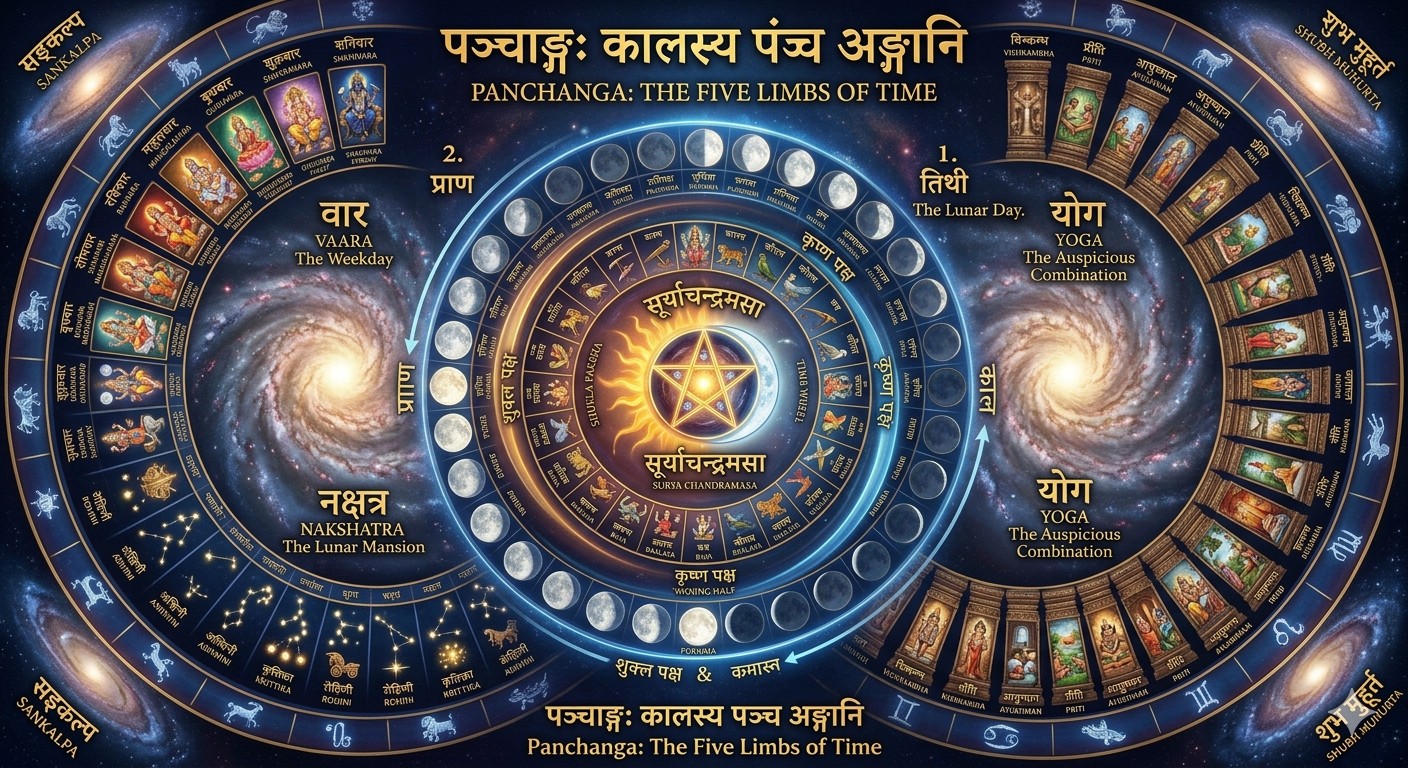
Image generated using Gemini AI
The five limbs of the PanchAnga are:
- tithI (तिथी) – lunar day
- vAra (वार) – weekday
- nakshatra (नक्षत्र) – lunar mansion/star
- yoga (योग) – luni-solar combination
- karaNa (करण) – half-lunar day
Conservative PanchAnga makers still use the formulae and equations found in the Surya Siddhanta to compile and compute their almanacs, which are annual publications in all regions and languages of India containing calendrical information on religious, cultural, and astronomical events.
The Tracking of Time in Surya Siddhanta
The Surya Siddhanta tracks time by calculating the Sun’s transit through the twelve sidereal Rashis (राशि = signs of the zodiac), an event called a Sankranti (सन्क्रान्ति). In Chapter 1 Madhya-gati, the text explicitly defines the mechanism for inserting the intercalary month:
“If two lunar months terminate when the Sun is only in one sign of the Zodiac, the second of these is called adhimAsa (an additive or intercalary month).”
In simpler terms, a standard lunar month always hosts exactly one Sankranti. However, because a lunar month is shorter than a solar month, the gap steadily accumulates. Every 2.7 years, a lunar month occurs during which the Sun does not cross into a new zodiac sign at all (zero Sankrantis). The Surya SiddhAnta mathematically isolates this specific period, “doubling” the month to reset the celestial clock.
Furthermore, the text uses this relationship to compute ahargaNa—the total number of elapsed civil days from the beginning of an epoch. In a solar calendar, ahargaNa can be obtained simply by counting the days. However, the problem arises when dates are given using a luni-solar calendar, in which after a regular period, an intercalary month is added to match it with the solar calendar. AhargaNa calculation essentially started with the Siddhanta texts. In PanchasiddhAntika (400 CE), of varAhamihIra, the weekday is obtained from ahargaNa. By maintaining a strict cosmic ratio over a Yuga (where 51,840,000 solar months dynamically map to 1,593,336 Adhika mAsas), ancient rishis achieved an extraordinary baseline for structural calendar accuracy without digital computers.
Spiritual Significance: From “Mala” to “Purushottama”
While its origins are purely mathematical, the significance of Adhika mAsa is deeply spiritual. Historically, it was called Mala mAsa (the soiled or unclean month) because, lacking a solar transit, it was considered unfavourable for material milestones like weddings, housewarmings, or starting a business.
However, ancient lore tells a story of divine transformation. Feeling rejected, the personified month appealed to Lord Vishnu. Moved by compassion, Vishnu assigned the month to Himself, naming it Purushottama mAsa (the month of the Supreme Being).
Consequently, Adhika mAsa is considered a highly sacred time for inner work. Freed from worldly celebrations, it is dedicated to:
- Self-reflection and meditation (DhyAna)
- Acts of charity and selfless service (DAna)
- Chanting, fasting, and spiritual detoxification (DhAraNA)
A Timeless Synthesis and Its Significance Today
Adhika mAsa is a shining testament to ancient Indian wisdom. It beautifully illustrates a worldview where science and spirituality do not contradict each other, but dance in perfect unison. By utilizing the precise astronomical mechanics laid out in the Surya SiddhAnta, the ancients ensured that humanity remained in rhythm with the universe—transforming a mechanical cosmic correction into a profound window for spiritual renewal.
For us today, its significance lies in offering a meaningful pause from routine life, encouraging reflection, detachment, and conscious living in harmony with cosmic order.
References
- Adhik Maas explained https://panditsnearme.com/blog/adhik-maas-significance#:~:text=What%20is%20Adhik%20Maas%3F,place%20during%20a%20lunar%20month
- The concept of Adhik Maas http://aryabhatt.com/articles/The%20concept%20of%20Adhika%20Masa.htm#:~:text=The%20length%20of%20an%20solar,(10.896%20days)%20per%20year
- Hindu Calendar http://vedicastrology.wikidot.com/hindu-calendar#:~:text=Verse%2D20%20in%20M%C4%81n%C4%81dhy%C4%81ya%20of,(into%20twelve%20r%C4%81shis).%22
- Nilesh Oak and Rupa Bhaty https://www.indica.today/research/research-papers/ancient-updates-to-surya-siddhanta/