


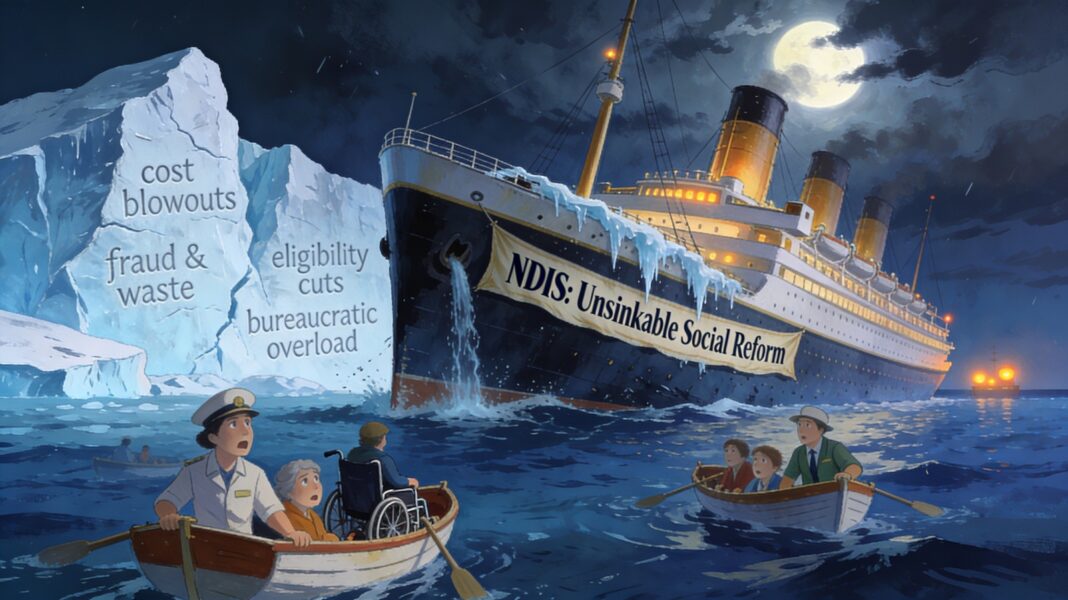
When the National Disability Insurance Scheme (NDIS) (“the Scheme”) was introduced in 2013, it was hailed as one of Australia’s most ambitious and compassionate social reforms since Medicare. It promised dignity, autonomy, and genuine choice for people with disability, a long-overdue shift away from charity-based models toward rights-based citizenship. Those who worked in the disability sector of government during that era report that the optimism was palpable. It has changed lives, expanded horizons, and given dignity to many who were marginalised from mainstream society for too long.
A decade on, the picture is more complicated. The NDIS has changed lives that is undeniable. But it is also showing unmistakable signs of strain: fraud at scale, market distortion, bureaucratic overload, and costs outpacing projections. The question is no longer whether the NDIS is struggling. It is whether Australians are willing to confront the scale of the problem before the scheme becomes financially and ethically unsustainable. NDIS Minister Mark Butler has argued the scheme “costs too much and is growing too fast,” and that six in ten Australians believe the scheme is “broken.” If no changes are made, experts predict it will cost $70 billion annually by 2030. The government’s stated goal is to return the NDIS to its original intent and improve financial sustainability.
We argue that the NDIS is at a critical turning point. Without decisive structural reform, the scheme risks drifting further into dysfunction leaving participants underserved, taxpayers frustrated, and the broader disability sector exhausted.
The Scheme briefly (2025)
Participants: 739,414: as of 30 June 2025 (NDIA Quarterly Report Q4 2024–25)

Annual Expenditure: ~$45–50 billion: growing at 10.8% year-on-year as of June 2025

Estimated annual misappropriation: ~$2 billion; NDIS Head of Fraud and Integrity, 2024

Providers with problematic claiming: 2,100+; NDIS Crack Down on Fraud program

Workforce turnover rate: 16–26% per annum; NDS Workforce Census Report 2024

Providers with financial losses (2023–24): 55.7%; NDIS Provider Outlook Report 2025
Fraud: Worrying, Ongoing, and A Symptom of Structural Weakness
Recent media investigations and law enforcement operations have exposed a troubling pattern. In one widely reported Western Sydney case, a provider was accused of laundering millions through fraudulent NDIS claims allegedly billing for services never delivered, with police seizing cash and weapons during the raid. The case is now before the courts.
This is far from isolated. In 2024, NDIS Head of Fraud and Integrity John Dardo disclosed that approximately $2 billion is being misappropriated annually (National Audit Office, 2025). Fraudulent activities range from luxury holidays and mortgage payments to inflated invoices and ghost services. In June 2024, the Australian Financial Review reported that some unregistered travel operators were using short-term respite funding to pay for trips to Disneyland Japan or helicopter tours of the Barossa Valley at costs of up to $20,000 per participant (Wikipedia, NDIS).
An NDIA deputy chief executive acknowledged that fraud is happening “on a malicious scale,” with 2,500 providers historically claiming over $5 billion in suspicious payments. He admitted, however, that the NDIS does not yet have a reliable way to collect proper statistics on identity theft and false claims.
The Fraud Fusion Taskforce has launched more than 635 investigations since its creation in November 2022, with the rate of successful criminal prosecutions doubling. In the first four months of 2025 alone, the NDIA participated in the execution of 35 warrants — compared to just 30 warrants across the entire four-year period from 2018–2021.
As a result of crackdowns, $86 million worth of claims were rejected, and 20,000 high-risk claims are now being reviewed every month. The government has invested more than $550 million in NDIS integrity and compliance since 2022.
A National Audit Office report concluded that “prior to 2024, the NDIS lacked basic prevention controls for fraud and non-compliance.” The Fraud Fusion Taskforce, established in November 2022, now includes 23 agencies working together. In two years, authorities launched more than 600 investigations and executed 65 search warrants. The 2025–26 Federal Budget committed an additional $151 million over four years to the Crack Down on Fraud program. Yet fraud is not merely a criminal justice problem. It is a symptom of a deeper structural weakness: a system designed as a market, without adequate regulatory muscle to police it.
Marketisation Gone Too Far
The NDIS was built around a quasi-market model: participants receive individualised budgets and choose their own providers. In theory, competition drives innovation and quality. In practice, the market has outpaced regulation.
Between 2014 and 2024, registered disability service providers grew more than tenfold from just over 2,000 to more than 20,000 (NDS, 2024). In metropolitan areas, provider numbers have exploded, but quality varies wildly. In regional and remote communities, “thin markets” mean participants often have no real choice at all. Price caps distort wages and working conditions, contributing to workforce shortages. In 2023–24, 55.7% of NDIS providers reported operating at a financial loss up from 51.4% the previous year (NDIS Provider Outlook Report 2025), a sign that the market model is undermining the very sector it was designed to energise.
The result is a system where the most vulnerable people are expected to behave like informed consumers in an often-fraudulent market. A house cleaned five times to maximise billable hours. Plans poorly constructed from the outset, with participants left to discern quality while one major provider bulldozes them. The NDIS was never intended to become a free-for-all commercial environment but that is increasingly what it has become.
Bureaucracy as Burden, Not Safeguard
As fraud and overspending increased, the NDIA responded with tighter controls, more assessments, and more administrative hurdles. This created a paradox: the people most in need of support are burdened by the very processes meant to protect them.
Participants and families have spoken about long delays, repeated assessments, opaque decisions with no explanation, stressful appeals, and a creeping return to medical model thinking. A social worker serving one family lamented that it has become “a fixed one-way entry to creeping medical model thinking.” Everyone – professionals, families, participants – spends more time justifying support than delivering it. Families feel “managed” rather than empowered.
Research supports these accounts. Hamilton et al. (2025) found that people with lived experience of psychosocial disability continue to face significant barriers to choice and control despite the scheme’s stated principles. Hummell et al. (2025) document the drift from NDIS intention to implementation, identifying a persistent gap between policy design and on-the-ground reality.
This bureaucratic overcorrection is understandable but counterproductive. It punishes honest participants and ethical providers while doing little to deter sophisticated fraudsters. A system designed to empower people with disabilities should not exhaust them.
The Economic Warning Is Flashing
The NDIS now costs more than $45 billion annually, projected to reach approximately $50 billion in 2024–25. The Treasury has warned that without reform; scheme costs could approach $100 billion within a decade. To put this in perspective: NDIS spending is the Commonwealth’s second-fastest growing expenditure, trailing only government debt interest payments.
The 2024 reform package [the NDIS Amendment (Getting the NDIS Back on Track No. 1) Act] is expected to reduce projected scheme expenses by $19.3 billion over four years to June 2028 (NDIA, 2025). Growth has moderated: from 22% in 2021–22 to 10.8% by June 2025, with the National Cabinet target of 8% growth by July 2026 within reach. This is genuinely encouraging. But it should not be mistaken for structural reform.
Disney et al. (2025) document deep social inequalities in NDIS eligibility and usage patterns from 2016 to 2022, evidence that the scheme has never served all Australians with disability equitably. Meanwhile, the Grattan Institute’s 2025 report, Saving the NDIS, argues that rebalancing disability services, strengthening non-NDIS community and foundational supports, is essential to reduce unsustainable dependency on individual plans (Bennett, Jessurun & Orban, 2025).
The original NDIS design included Tier 1 and Tier 2 supports: community-level services, early intervention, and mainstream inclusion. These were never properly implemented. The NDIS has consequently become the default provider for needs that should be met by housing, mental health, education, and community services. No insurance model can withstand that pressure indefinitely.
A Workforce Burning Out
The human cost of these systemic failures falls hardest on workers. Annual turnover rates in the disability workforce sit between 16% and 26%; three times the rate of the broader Australian workforce (NDS Workforce Census Report 2024). Each new hire costs providers between $2,130 and $3,320 to onboard. In 2024, the sector experienced a net loss of 1,246 permanent disability support workers, offset only by growth in casual roles, a survival strategy and not a preference (NDS, 2025).
A 2025 qualitative study of physiotherapists and occupational therapists in the NDIS community sector found burnout to be widespread and acute. As one participant described: “The OTs are struggling and they are burning out and leaving the industry quicker than they’re joining” (Burnout in physiotherapists and occupational therapists, Disability & Rehabilitation, 2025). Brown et al. (2025) similarly found participant perspectives darkened by the quality and consistency of allied health support, a direct consequence of workforce instability.
The NDIS Review (2023) projected that 385,000 disability support workers would be needed by mid-2025, up from 280,000 in 2021–22 that is a 40% increase. Whether that target has been met remains unclear. What is clear is that legitimate professionals are struggling to advocate for participants while navigating fractured funding lines. Burnout is rising; the workforce shortfall is deepening. A system that exhausts its workers cannot deliver quality support.
Public Confidence Is Eroding
Every social insurance scheme depends on public confidence. Medicare endures because Australians trust it. The NDIS will survive only if Australians believe that funds are used appropriately and that fraud is punished.
That confidence is fraying. The NDIS is increasingly portrayed in the media as financially out of control, poorly regulated, and ripe for exploitation. Activist investigations have gone viral. The Treasury is modelling cuts. Politicians are eyeing means-testing. When the scheme designed to deliver dignity becomes a headline for rorting, the social contract that sustains it is in danger. Some experts have raised concerns that a new NDIS planning framework drawing on algorithms to set plan budgets could be likened to “Robodebt” — so-called “robo-planning.” Critics argue that rigid “in” and “out” funding lists have already reduced creativity and in some cases increased scheme costs.
For people with disability already experiencing cost-of-living challenges and housing unaffordability, assurances of continued scheme growth will be cold comfort — particularly with reductions in social and community participation funding beginning as early as July 2026.
Major Proposed Reforms
Eligibility Changes
The government wants to move away from using medical diagnoses to determine entry and instead focus on functional capacity — meaning eligibility will be based on how much a person’s impairments impact their daily life. New standardised assessment tools are being developed. This means a diagnosis alone will no longer guarantee access.
The government’s goal is to reduce the number of participants from 760,000 to around 600,000 by the end of the decade. New eligibility criteria won’t be fully in place until at least 2028, as a technical advisory group still needs to develop the tools.
New Planning System and Funding Cuts
Support needs assessments are being introduced from mid-2026 as part of a new planning framework to create fairer and more consistent budgets. These will be culturally appropriate, trauma-informed, and diversity-enabled. Participant support budgets for social, civic and community participation supports, and capacity building daily activities will be progressively adjusted from 1 October 2026.
Provider Registration Overhaul
New mandatory registration is starting in mid-2026 for providers of specific support types, including Supported Independent Living (SIL) providers. There are currently 276,581 active NDIS providers, and the move aims to improve oversight — though critics warn that forcing all providers into one-size-fits-all registration could limit participant choice.
Digital Payment System
A new digital payment system is being introduced to give better visibility over claims made to the NDIS and to ensure they are genuine. The government is also reducing the number of organisations able to operate as plan managers and cutting the number of unscheduled plan reassessments.
“Securing the NDIS for Future Generations” Bill
The government has flagged it will introduce the National Disability Insurance Scheme Amendment (Securing the NDIS for Future Generations) Bill following the release of the 2026-27 Budget, building on recommendations from the Independent NDIS Review and the Royal Commission into Violence, Abuse, Neglect and Exploitation of People with Disability.
What Must Change
No one wants the NDIS to be disbanded, rather people are calling for honest, courageous reform across four fronts:
- Strengthen regulation. Real-time audits, mandatory provider accreditation, harsher fraud penalties, and proactive monitoring of high-risk providers are essential. The 2025 legislation is a step forward and it must be implemented with full force.
- Rebuild community support. Significant investment in Tier 1 and Tier 2 mainstream disability inclusion will reduce NDIS plan dependency for basic needs. The Grattan Institute’s 2025 recommendations for co-funded foundational support with states deserve urgent implementation.
- Rebalance the market. Reduce dependence on for-profit suppliers. Prioritise quality over quantity. Actively support non-profit and community-based organisations, particularly in regional markets where commercial providers have no incentive to operate.
- Invest in the workforce. Competitive wages, genuine career pathways, manageable caseloads, and reduced administrative burden are not luxuries rather they are preconditions for a functioning scheme.
The NDIS Is Worth Saving
The NDIS remains one of Australia’s most morally significant undertakings. The NDIS is worth saving, but only if policymakers are willing to confront its failures with the same ambition that created it. A scheme built to expand choice and dignity cannot be allowed to harden into a system defined by fraud, administrative drag, and uneven access. The central test is no longer whether the NDIS has value; it is whether Australia is prepared to preserve that value through reform rather than neglect.
The questions now are unavoidable. How can a rights-based scheme remain credible if participants face delay, confusion, and inconsistent support? How can public confidence endure if weak oversight leaves room for exploitation at scale? And how can the NDIS remain sustainable if it continues to absorb responsibilities that should be carried by broader community and mainstream services?
The answer is not retreat, but repair. Australia should strengthen regulation, rebuild foundational supports, rebalance the provider market, and invest seriously in the workforce that makes the scheme function. The task is not to shrink the NDIS into something lesser, but to restore it to something durable, fair, and fit for purpose.”
The NDIS can still be rescued. But only if we act now, with honesty, courage, and a renewed commitment to the people the system was designed to help.
To report NDIS fraud: Call the NDIS Fraud Reporting and Scams Helpline on 1800 650 717 or submit an online report at ndis.gov.au.

References
- Bennett, S., Jessurun, M., & Orban, H. (2025, June 29). Saving the NDIS: How to rebalance disability services to get better results. Grattan Institute. https://grattan.edu.au/report/saving-the-ndis/
- Brown, M., D’Cruz, K., Oliver, S., Winkler, D., & Douglas, J. (2025). Understanding the NDIS experience: A qualitative study on participant perspectives. Brain Impairment, 26(2), IB24103. https://doi.org/10.1071/IB24103
- Disney, G., Yang, Y., Summers, P., Devine, A., Dickinson, H., & Kavanagh, A. M. (2025). Social inequalities in eligibility rates and use of the Australian National Disability Insurance Scheme, 2016–22: An administrative data analysis. Medical Journal of Australia, 222(3), 135–143. https://doi.org/10.5694/mja2.52594
- Hamilton, D., Scanlan, J. N., Brasier, C., & Hancock, N. (2025). Successfully navigating barriers to choice and control in the National Disability Insurance Scheme (NDIS): Experiences of people with lived experience of psychosocial disability. Advances in Mental Health, 1–13. https://doi.org/10.1080/18387357.2025.2565344
- Hummell, B., Carey, G., Malbon, E., & Reeders, D. (2025). Policy shifts and drifts: From intention to implementation of Australia’s National Disability Insurance Scheme (NDIS). Australian Journal of Public Administration, 1–20. https://doi.org/10.1111/1467-8500.12623
- Minister Mark Butler Speech. https://www.health.gov.au/ministers/the-hon-mark-butler-mp/media/minister-butler-speech-at-the-national-press-club-22-april-2026?language=en
- National Audit Office. (2025). Fraud prevention and compliance in the NDIS. Australian Government.
- National Disability Insurance Agency. (2025). NDIS Quarterly Report Q4 2024–25. NDIA. https://www.ndis.gov.au/media/7950/download
- National Disability Insurance Agency. (2025). Budget 2025–26: Strengthening the National Disability Insurance Scheme. Department of Health, Disability and Ageing. https://www.health.gov.au/resources/publications/budget-2025-26-strengthening-the-national-disability-insurance-scheme-html
- National Disability Services. (2025). NDS Workforce Census Report 2024. NDS. https://nds.org.au/news/new-report-finds-unprecedented-workforce-churn-of-50-per-cent-in-disability-sector
- NDIS Provider Outlook Report. (2025). State of NDIS providers: Challenges and outlook 2025. Nacre Consulting.
- NDIS Review. (2023). Building a more responsive and supportive workforce. Australian Government. https://www.ndisreview.gov.au/sites/default/files/resource/download/building-a-more-responsive-and-supportive-workforce_0.pdf
- Tran, S., & Sheridan, L. (2025). Burnout in physiotherapists and occupational therapists working in the Australian community disability sector under the NDIS: A qualitative study. Disability and Rehabilitation. https://doi.org/10.1080/09638288.2025.2476022
- Western Sydney University. (2025). Workforce issues in the disability sector. Sustainable Development Without Borders. https://westernsydney.pressbooks.pub/sdwb2025/chapter/workforce-issues-in-the-disability-sector/