


A Debate at a Crossroads
Australia’s international education and migration settings have become a focal point of renewed public debate. Concerns about visa integrity, housing pressures, and the scale of migration are increasingly shaping policy responses and public sentiment. At the same time, international education remains one of the country’s most significant economic sectors, creating a tension between regulation and reliance.
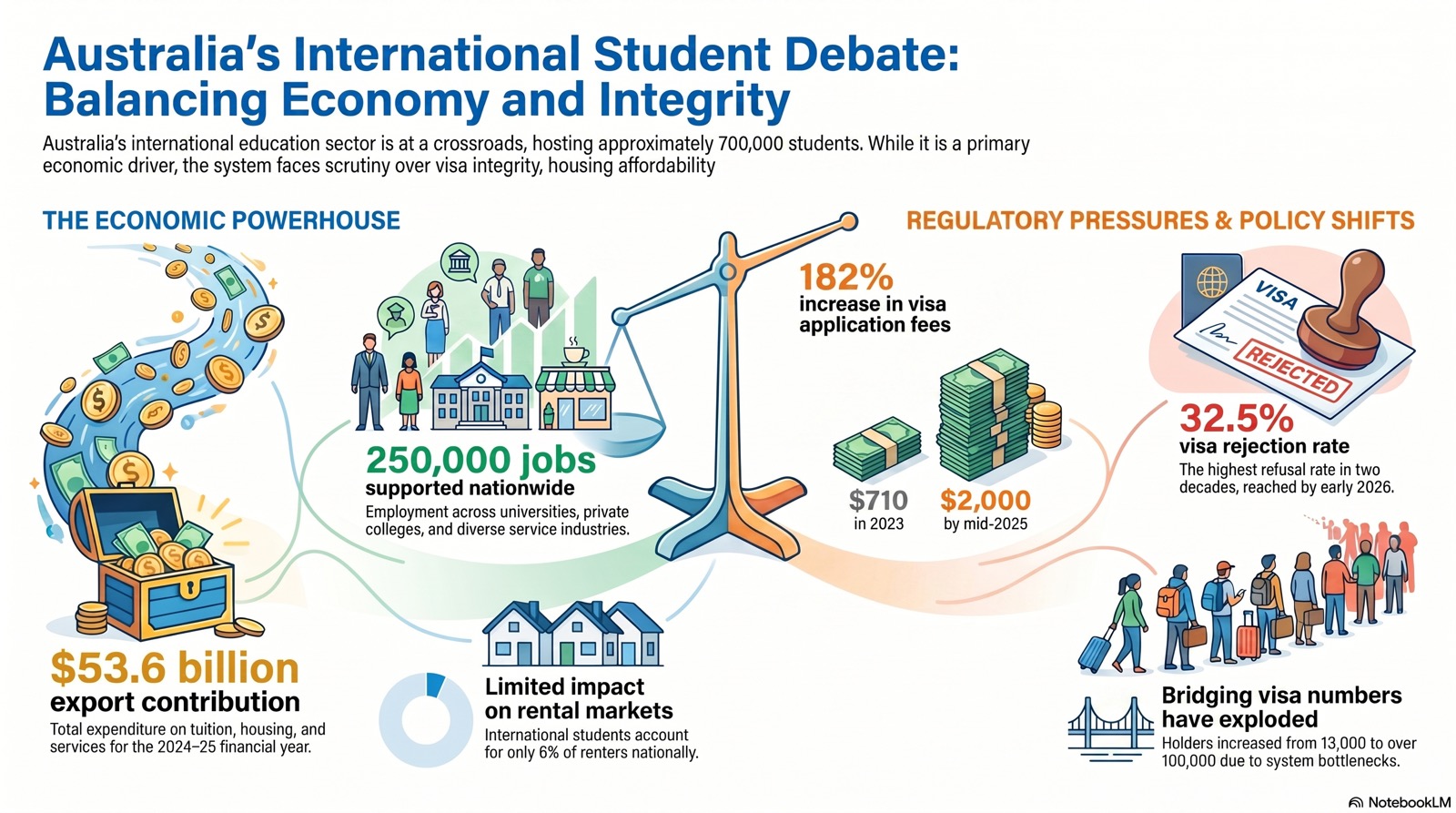
A useful starting point is scale. Australia currently hosts approximately 700,000 international students across higher education, vocational training, and English language sectors. Each year, the system processes hundreds of thousands of student visa applications, making it one of the largest managed migration streams in the country.
Bridging Visas and the Integrity Question
Within this system, concerns have been raised about course-hopping, visa misuse, and the use of bridging visas. Government data shows that the number of individuals on bridging visas has increased significantly in recent years, rising from around 13,000 to over 100,000. While this figure is often presented as evidence of systemic abuse, it requires context. Bridging visas are a structural feature of Australia’s migration framework, commonly issued during lawful transitions between visa types, appeals, or administrative processing delays. Their growth reflects both increased migration volumes and system bottlenecks, rather than exclusively fraudulent behaviour.
Australia has also strengthened integrity measures. The Genuine Temporary Entrant requirement, stricter English language thresholds introduced in 2024, and enhanced financial capacity checks are designed to ensure that applicants meet study and compliance expectations. These measures indicate that policy settings have already shifted toward tighter controls.
The Economic Case for International Education
At the same time, international education plays a critical economic role. According to the Australian Bureau of Statistics, international student expenditure contributed approximately $53.6 billion to export income in the 2024–25 financial year. This includes tuition fees as well as spending on housing, food, transport, and healthcare. The sector supports an estimated 250,000 jobs across universities, private colleges, accommodation providers, and service industries.
The Reserve Bank of Australia has also noted that education exports have been a significant contributor to post-pandemic economic recovery and GDP growth. Any abrupt contraction in student numbers would therefore have direct economic consequences, including job losses and reduced demand in local economies.
Rising Visa Fees and Rejection Rates
Policy changes over the past two years reflect an attempt to balance integrity with system sustainability. Student visa application fees have increased substantially, rising from $710 in 2023 to $2,000 by mid-2025. At the same time, visa rejection rates have climbed sharply. By early 2026, overall refusal rates reached approximately 32.5%, the highest in two decades.
This shift has had uneven impacts across regions. Approval rates for applicants from parts of South Asia and Africa have declined markedly, in some cases dropping below 30%. While higher refusal rates may reflect stricter enforcement of entry criteria, they have also raised concerns within the education sector about transparency, consistency, and reputational risk.
The financial implications are also notable. Because visa application fees are non-refundable, rejected applicants represent a significant revenue stream. Estimates suggest that hundreds of millions of dollars are collected annually from unsuccessful applications. Critics argue that this creates a perception of imbalance, where applicants bear increasing costs without corresponding clarity in decision-making processes.
Housing Pressures and the Role of Students
Beyond visa settings, housing has become a central issue in the broader migration debate. International students are often included in discussions about rental affordability, particularly in major cities such as Sydney and Melbourne. However, available data suggests their impact is more limited than commonly assumed.
International students account for approximately 6% of renters nationally, with a substantial proportion living in purpose-built student accommodation. This reduces their direct competition with the general rental market. Structural factors—such as limited housing supply, planning constraints, and long-term policy settings—play a more significant role in driving affordability challenges.
Labour Market and Worker Vulnerability
Labour market dynamics add another layer of complexity. International students contribute to sectors experiencing persistent workforce shortages, including hospitality, retail, and aged care. At the same time, evidence indicates that temporary migrants, including students, are more vulnerable to underpayment and exploitation. This reflects gaps in enforcement rather than inherent issues with the student cohort itself.
Acknowledging Real Integrity Concerns
It is also important to acknowledge that integrity concerns are not unfounded. There are documented cases of non-genuine students, fraudulent education providers, and misuse of visa pathways. Some individuals have used the protection visa system strategically, exploiting long processing times to extend their stay and work rights.
These issues point to weaknesses in system design and administration. Long delays in asylum processing—sometimes extending over several years—create incentives for misuse while also disadvantaging genuine applicants. Similarly, insufficient oversight of education providers can enable poor-quality institutions to operate within the system.
Reform Over Restriction: A Balanced Approach
Addressing these challenges requires targeted reform rather than broad restriction. Faster processing times, improved data sharing between agencies, and stronger regulation of providers would enhance integrity without undermining legitimate students. Precision in policy design is critical: distinguishing between non-compliance and normal system navigation is essential for maintaining both fairness and effectiveness.
Public Sentiment and Political Framing
Public sentiment also plays a significant role in shaping policy direction. Migration levels reached a peak of 556,000 in 2023, exceeding projections and placing pressure on infrastructure and services. Concerns about housing, transport, and urban capacity are widely shared across communities, including among migrants themselves.
Political responses to these pressures often involve selective framing of data, a common feature of democratic systems. Emphasising particular statistics or narratives can influence public perception, even when broader evidence presents a more complex picture. This dynamic underscores the importance of evidence-based policy discussion that reflects both risks and contributions.
Social Cohesion and Australia’s Global Reputation
Social cohesion is another consideration. Research from the Australian Human Rights Commission highlights that international students frequently experience exclusion, discrimination, and social isolation. These experiences can affect both wellbeing and Australia’s global reputation as a study destination.
Historically, international education has been one of Australia’s most effective forms of soft power. Students who study in Australia often maintain long-term professional, economic, and diplomatic connections with the country. Any perception of hostility or unpredictability in policy settings risks weakening this advantage.
Diaspora Engagement and Community Discourse
Within diaspora communities, including the Indian Australian population, engagement with these debates is evolving. While voter participation and political engagement have historically varied, there is growing awareness of how migration and education policies affect both current residents and future arrivals. Community-level discussions, particularly in culturally and linguistically diverse contexts, are likely to become increasingly important in shaping informed perspectives.
Integrity and Openness Are Not Mutually Exclusive
Ultimately, the current debate reflects a broader policy challenge: how to manage a high-volume migration and education system in a way that is economically beneficial, socially sustainable, and administratively credible.
International education is neither a vulnerability nor a panacea. It is a complex system that delivers substantial benefits while requiring careful regulation. Overly restrictive measures risk damaging a major export industry and Australia’s international standing. At the same time, insufficient oversight undermines public confidence and system integrity.
A balanced approach would prioritise:
– Efficient and timely visa and asylum processing to reduce system exploitation
– Transparent and consistent decision-making criteria
– Stronger regulation and auditing of education providers
– Targeted enforcement against non-compliance rather than broad-based restrictions
– Alignment between migration levels and infrastructure planning
These measures recognise that integrity and openness are not mutually exclusive. A well-functioning system depends on both.
The direction of policy in this area will continue to be shaped by economic needs, public sentiment, and political incentives. Maintaining a focus on evidence rather than rhetoric is essential to ensuring that decisions reflect long-term national interests rather than short-term pressures.
Sources:
- https://www.abs.gov.au/statistics/detailed-methodology-information/information-papers/recording-international-students-balance-payments
- https://www.rba.gov.au/publications/bulletin/2025/jul/international-students-and-the-australian-economy.html
- https://www.goinconnect.com/knowledge-articles/australias-international-student-cap-for-2025-why-we-need-to-rethink-this-risky-move
- https://www.thetraveler.org/australias-student-visa-crackdown-drives-rejections-fee-hikes/
- https://monitor.icef.com/2024/07/australia-implements-immediate-225-increase-in-student-visa-application-fees/
- https://monitor.icef.com/2026/02/australia-full-year-data-for-2025-reveals-impact-of-aud2000-study-visa-application-fee-on-elicos-sector/
- https://monitor.icef.com/2024/02/australia-visa-rejection-rates-spike-as-some-institutions-withdraw-admissions-offers-under-new-migration-settings/
- https://www.aiaig.com/en/investment-news/australia-student-visa-rejection-record-high-2026
- https://www.timeshighereducation.com/news/australia-earns-millions-turning-away-international-students
- https://humanrights.gov.au/resource-hub/by-resource-type/publications/race/interim-report-racism-australian-universities
- https://humanrights.gov.au/about/news/media-releases/commission-delivers-interim-report-racism-australian-universities
- https://humanrights.gov.au/about-us/media-centre/media-releases/race/landmark-study-finds-racism-is-widespread-and-systemic-at-australian-universities
- https://melbourneasiareview.edu.au/how-australian-universities-must-tackle-racism-against-chinese-students/
- https://umsu.unimelb.edu.au/news/article/7852/A-cap-on-international-students-is-a-threat-to-all-Australian-universities/