

The wise sages in ancient India recognised an enduring truth:
Ekam sat vipraaha bahudhaa vadanti [1]
Truth is one, the learned speak it in different ways
– ṛgveda (1:164:46)
Yet from history to the present day, this insight has been resisted, ridiculed, or rejected by those claiming exclusive ownership of truth. The consequences of this intolerance are not abstract. They shape the lived experiences of individuals, communities and nations.
Intolerance manifests in everyday life.
Raj (name changed) an 18-year-old Hindu, was labelled a “devil-worshipper” by a religious classmate who saw a Murthi of Ganesha on the dashboard of his car. [2]
Public discourse reflects a similar pattern. A political candidate in Texas recently denounced a Hindu statue as a “false god,” drawing widespread approval online. [3] In many societies, language itself becomes a weapon—terms like “kafir,” “pagan,” or “dothead” aim to reduce individuals to caricatures of “the other.” [4]
These examples are not isolated—they point to a broader psychological pattern.
What drives the pattern? At its root lies a form of insecurity: difference anxiety.
Difference Anxiety: A Primer
Difference anxiety is a discomfort with, or inability to accept, difference. [5] In a multi-cultural democracy like Australia—defined by religious, linguistic, and cultural diversity—how we respond to difference matters deeply.
Responses to difference exist along a spectrum:
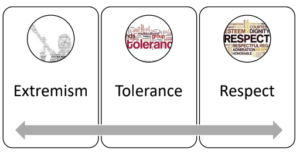
The table below defines each stage, the etymology and response to difference.
|
Stage |
Definition |
Root Meaning from Latin |
Difference Is: |
| Extremism | The rejection of difference through violence or dehumanisation. | Exterminare: To drive beyond boundaries. | To be eradicated from a closed, hierarchical architecture |
| Tolerance | The act of “putting up with” something perceived as inferior. | Tolerare: To bear, endure, or suffer. | To be grudgingly endured within a hierarchical architecture |
| Respect | Regarding the “other” with esteem and equal worth. | Respectus: To look again; to regard. | To be integrated in an open architecture |
Respect as an Open Architecture:
At its highest expression, difference is met with genuine respect—an attitude grounded in humility.
The philosophical traditions of Bhārata, particularly within Sanātana Dharma, approach difference with mutual respect. Concepts such as the inherent divinity of all beings (ātman/brahman), the interconnectedness of life (vasudhaiva kuṭumbakam) and equal regard for all paths (sarva dharma samabhāva), create a framework where diversity is not threatening and can be integrated into an ‘open architecture.’ [5] Such perspectives historically enabled intellectual and cultural pluralism to coexist with economic and spiritual freedom, enabling enduring flourishing in Bhārata. Angus Maddison notes that India, prior to colonisation, was either the largest or second largest economy in the world for the two millennia he studied. [6]
The Slippery Slope of Tolerance:
Toleration comes from the Latin ‘tolerare’ – meaning to bear, to endure, to suffer. Like tolerating pain, a bad day in the office, or a partner’s abuse. It entered English via Old French, and initially meant permission granted by authority. Thus, someone in a superior position tolerated the activities of another in a subordinate position. Toleration implies a power imbalance. One side occupies the position of giving or withholding permission to the other. Tolerance reinforces difference, and teaches us that difference is something inferior and must be ‘put up with’ anyway.
Tolerance, though often seen as a virtue, is limited. Historically, it also carried a power dynamic: those in authority “permitted” the existence of others. This distinction matters. A society that merely tolerates difference remains fragile; it can easily regress into conflict and extremism.
Exclusivist frameworks—religious or ideological—may allow for tolerance but struggle to fully embrace difference. When only one path is seen as valid, alternatives are often viewed as errors to be corrected, absorbed, or erased.
Certain interpretations within Abrahamic traditions have historically emphasised a singular monopoly on the means to salvation (sola scriptura). This allows the tradition to tolerate different beliefs but not accept or respect alternatives. Hence, differences must be erased, cultures homogenised and people assimilated.
Perhaps because of its Abrahamic moorings and insufficient depth of knowledge of other traditions, there is a level of mainstream and bipartisan tolerance in Australia. While necessary, it is insufficient and all too easy to slip.
Intolerance operates as a multi-headed phenomenon, manifesting in different but interconnected forms. In Australia, one such expression is Hinduphobia, evident in extremist attacks on Hindu temples in Melbourne. Another is political reluctance—such as that attributed to the Greens—to explicitly condemn terrorist violence against Hindus in regions including Pakistan, Bangladesh, and Kashmir’s Pahalgam or the violence against Jews on October 7th. At its core, intolerance is driven by what can be understood as “difference anxiety”: a progression along a continuum in which perceived difference is first resisted, then rejected, and ultimately met with kinetic, even violent, responses. At this extreme, human lives are devalued and serious crimes are minimised or ignored. Before, during and after violence, apologists for extremism construct narratives that obscure or deny such atrocities, thereby further diminishing the recognition and dignity of the victims.
As painfully evidenced on December 14, 2025 at Bondi Beach or in the outpourings of anti-immigration protesters, the presence of difference anxiety exists in Australia, often rooted in a lack of awareness and knowledge; as a result, individuals default to an instinctive tendency to label and reject what is unfamiliar.
Difference anxiety seeks the solace and refuge of homogeneous ideas, beliefs and identity even though it runs counter to the nature of the world. Diversity is inherent to life, from plants, animals, people, and at every level of the cosmos.
Difference Anxiety from Above
Rajeev Malhotra argues in Being Different that “difference anxiety” manifests through deliberate and structured responses to the “other”: it may operate from ‘above’ through destruction—via violence or coercive conversion—through the systematic isolation of communities so they no longer appear threatening, or through inculturation, a process that infiltrates another’s identity to dilute and ultimately absorb it. [5]. This framework makes clear that intolerance is neither accidental nor benign; it is enacted through identifiable mechanisms.
Isolation, for instance, is not abstract—it appears in everyday interactions. When someone dismisses another with “I don’t understand your accent” and disengages, or when employer bias is obscured behind claims that “the candidate was not a cultural fit,” exclusion is being actively enforced under the guise of neutrality.
Inculturation, meanwhile, is more subtle yet equally consequential. Historically associated with institutions such as the Roman Catholic Church, it has been used in parts of Africa, Latin America, and Asia as a strategy of entry—making superficial accommodations to lower resistance, only to advance proselytisation and ultimately erase difference. This is not a process grounded in mutual respect, but a calculated approach aimed at the dissolution of distinct identities.
In the Conquest of America, Tzvetan Todorov explains how the Spanish conquistador Hernan Cortes studied the Incan natives for the purpose of erasure. “Cortes took an interest in the other, at the cost of a certain empathy or temporary identification. Cortes slips into the other’s skin, thereby ensuring himself an understanding of the other’s language and political organisation. In so doing, he has not abandoned his feeling of superiority; it is even his very capacity to understand the other that confirms him in that feeling. Next he is not content to reassert his identity which he has never really abandoned, but proceeds to assimilate the Indians to his own world.” [5]
Difference Anxiety from Below
Difference anxiety is not just the preserve of those in power. It can occur from ‘below’ too. Those who experience their cultural identity as stemming from a position of weakness often feel compelled to erase the difference in order to appear less strange, less inferior, or at least understood within the frame of reference of those in or with or who can bestow power. Examples abound in society and manifest in many forms. Thus candidates change their names on their Curriculum Vitae: Govardhan becomes Gary, Janaki becomes Jane. Recent arrivals fake their accents or take up drinking to fit in, socially. Immigrant children live double lives, displaying contrasting values when at home compared to when they are with their friends from school or university.
The former Governor of Louisiana, Bobby Jindal (known as Piyush Jindal, prior to his conversion) disturbed many by the extent to which he pandered to an ultra-Christian conservative (mostly white) base in his state, where being Christian is often a necessary prerequisite for public office. Jindal’s assimilation, to some, seemed more like a conscious decision to actively distance himself from his heritage. The caricature was complete when Jindal was ridiculed for an official portrait that hung in his office, devoid of his natural pigmentation. [8] Jindal’s approach stands in contrast to the approach of Vivek Ramaswamy whose outreach was based on an inner confidence that did not require external compromise.
Being and Staying Different in Australia
Being and remaining different amid the pressures to shed one’s difference requires a self-confidence and self-assurance that is arrived at by self-knowledge, and a recognition that not all are the same, nor do they need to be. It is far better to gain respect for who you are, rather than gain transitory acceptance or tolerance through pretence.
Difference anxiety provides a powerful frame through which to regard interactions among diverse cultural, religious groups and to introspect on community and individual approaches to differences encountered at school, in the office and in the community.
In pragmatic terms, those that are different are responsible for sharing the merits of that difference, by playing to their strengths and being visible about how it can add value to the mainstream. The mainstream culture can gain greater benefits by encouraging and celebrating diversity beyond having it as a quaint culinary or lifestyle accessory. An example is leveraging the diaspora for robust and more durable trade ties with Australia’s trading partners.
The Royal Commission on Anti-Semitism and Social Cohesion, as constituted on 9 January 2026, must be seen as an opportunity to reject difference anxiety and build a society with mutual respect and with self-regulation in civil discourse, political leadership and community interaction. All of us have a responsibility to confront and end the rising intolerance in the country we call home.
Rejecting Intolerance
The Philosopher Karl Popper notes that a tolerant society must be willing to defend itself against forces that seek to destroy it.
If we extend unlimited tolerance even to those who are intolerant, if we are not prepared to defend a tolerant society against the onslaught of the intolerant, then the tolerant will be destroyed, and tolerance with them”. [8]
Our Common Home
Ancient wisdom offers a fitting conclusion:
janam bibhrati bahudhā vivācasaṃ nānādharmāṇa pṛthivī yathaukasam
– Atharva Veda (12:1:45)
The Earth, which holds people of diverse speech and different faiths, provides a home to all.
The task before us is simple, though not easy: to transform diversity from a source of anxiety into a foundation for mutual respect. A society that learns not merely to tolerate difference, but to respect and learn from it, transforms diversity from a source of anxiety into a foundation of strength.
References:
[1] Rig Veda
[2] Interview conducted March 1, 2026, Melbourne, Australia. Interviewee seeks anonymity.
[3] MSN, 24 September 2025, URL: https://www.msn.com/en-in/politics/government/false-hindu-god-republican-leader-alexander-duncan-faces-criticism-for-controversial-post-on-lord-hanuman-statue-in-texas/ar-AA1N6YmC
[4] HAF, 2026, URL: https://www.hinduamerican.org/hindu-hate-glossary Retrieved: March 1, 2026.
[5] Malhotra, R. (2011). Being different: An Indian challenge to Western universalism. HarperCollins Publishers India.
[6] Maddison, A. (2001) The World Economy, A Millenial Perspective, OECD.
[7] News.com.au (2015) URL: https://www.news.com.au/technology/online/social/us-politician-bobby-jindal-depicted-as-white-man-in-portrait-hanging-in-louisiana-state-capitol/news-story/6918590a96ab2776218e576fa93b0430
[8] Popper, K. R. (1966). The open society and its enemies (5th ed., Vol. 1). Routledge. (Original work published 1945)