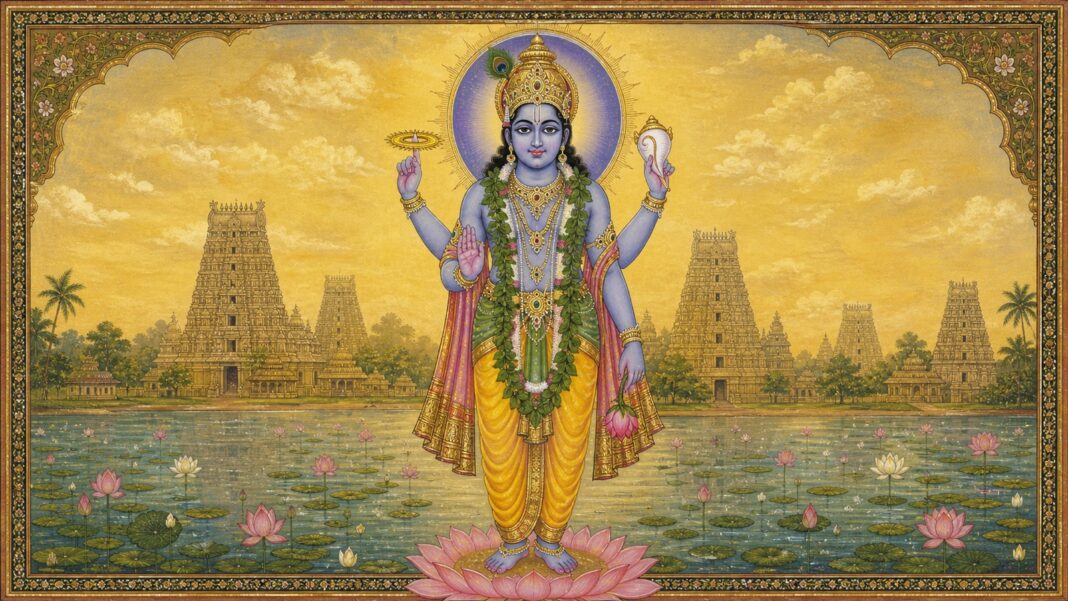


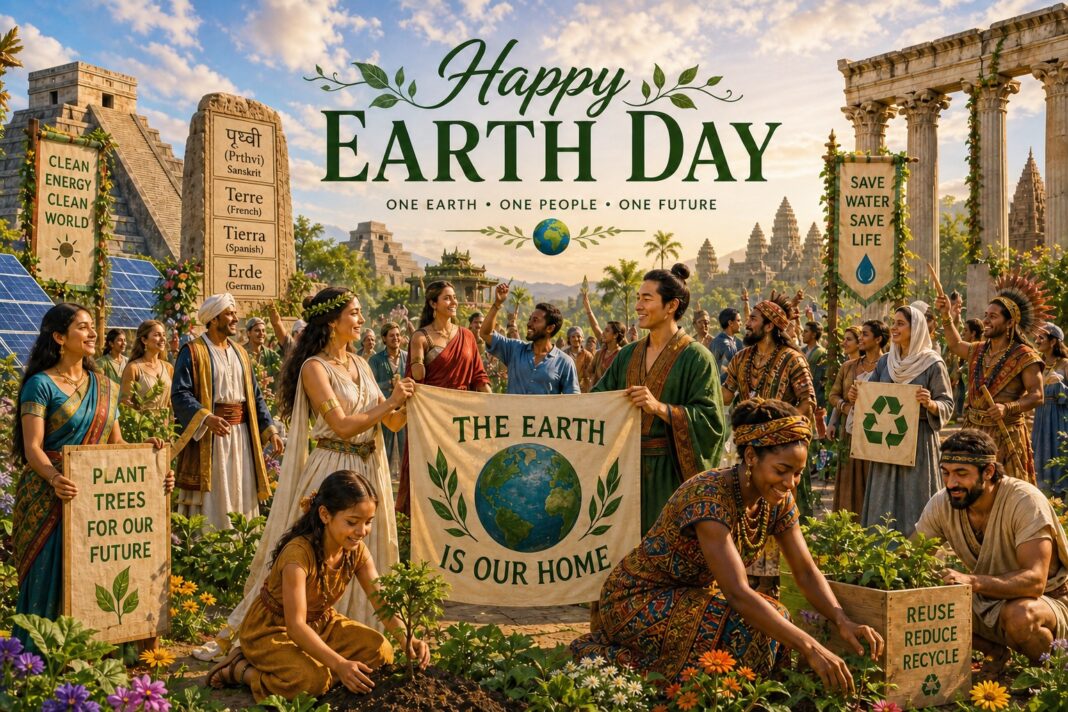
Earth Day falls on 22 April, each year, a tradition that began in the year 1970, in the US. The day is marked globally in support of environmental protection, first held in 1970. Since then, it is said that over a billion people in over 193 countries have been involved in environmental actions that reduce pollution and protect biodiversity. The day is a reminder to adopt sustainable habits daily. Early on the Earth Day success is widely credited to building of consciousness that has resulted in the creation of the U.S. Environmental Protection Agency in the following year. For Bhārata with her ancient civilisation, the Earth Day symbolism echoes with the ethos and spirituality connecting humans to Mother Nature.
Mother Earth and Sanātana Dharma
Ancient literature and teachings from Bhārata and Sanātana Dharma provide us with the amazing breadth and depth of information about living a harmonious life along with other life on our planet. Mother Earth is not merely a planet or a resource, but a living, sacred entity known as Bhūmi Devi (भूमि देवी) or Prithvi (पृथ्वी). This, the oldest known spirituality, advocates for a deep, symbiotic relationship with nature, viewing all natural elements—earth, water, fire, air, and space—as manifestations of the divine.
As per Charaka Samhita all matter is divided into 3 categories based on their origin – Jaṅgama (जंगम = mobile – that moves from one place to another, animal kingdom), Audbhida (औद्भिद = that which emerges from the earth, plant kingdom) and Pārthiva (पार्थिव = minerals, that which remains deeply under requiring mining and silting). Ancient Hindu scriptures, such as the Manusmṛti (मनुस्मृति), prescribe that when any fruit-bearing tree is cut, chanting of a set of Vedic hymns must accompany as a ritual of apology and atonement. Such injunctions also propagated the practice of ethical restraint i.e. that natural “resources” may be exploited. Ancient vision of sacred spaces where trees that shelter animals, purify air and anchor soil aligns closely with today’s climate justice and reforestation movements.
The Hindu concept of vanaspati offers a profound reminder that our relationship with trees and plants is not just ecological, but deeply spiritual and ethical. In the ancient Vedic imagination, vanaspati is both “Lord of the Forest” and a symbol of the plant kingdom’s sacred role in sustaining life, long before modern science coined the term “biodiversity”.
Plant classification in Hindu scriptures is a comprehensive system found in ancient texts like the Vedas, Purāṇas, Manusmṛti, and Vrikshayurveda, classifying flora based on morphology, growth habits, and utility. Such botanical knowledge offered recognition of plants as sentient beings, dividing them into categories that reflect their appearance and ecological roles.
Plant Classification by Morphology & Growth (Manusmṛti & Purāṇas)
The Manusmṛti and various Purāṇas classify plants into eight distinct categories:
- Oṣadhi (or Oshadhi, ओषधि = herb): Plants that wither and die after bearing fruit, primarily annuals like rice and wheat.
- Vanaspati (वनस्पति): Trees that produce fruits without any visible flowers, such as the jackfruit or peepul.
- Vṛkṣa (वृक्ष): Trees that bear both flowers and fruits, such as mango or neem.
- Guccha (गुच्छ): Bushy plants or shrubs.
- Gulma (गुल्म): Succulent shrubs or bushy herbs.
- Trina (तृण):
- Pratana (प्रतन): Creepers that spread their stems along the ground.
- Vallī (वल्ली): Twiners or climbing plants.
This classification is not merely taxonomic; it reflects a worldview in which vegetation is conscious and interwoven with the divine, as expressed in the principle “Vasudeva sarvam” (the Supreme resides in all beings) and “Sarva bhūta hita” (welfare of all beings).
Similarities in Aboriginal culture
Aboriginal culture expresses its caring for the country: land, waters, animals, and people and sees interconnections. In many Aboriginal traditions, Country is a living relation and a source of identity, law, spirit, and responsibility rather than property to be owned.
For Aboriginal people, Mother Earth is their teacher of traditional knowledge and, therefore, the ultimate custodian of lore and law. Originally, Aboriginal people did not write information on parchment. They orally recited stories and histories, including the Earth’s and Heavens’ natural features and colours. For example, colours in the sky seem to indicate the best time and direction to travel. Aboriginal people shun any inappropriate modifying of Mother Earth that could erase histories and knowledges within it. They continue the passing down knowledge about care for the Country through generations.
European-derived perspectives that position humanity as having dominion over Nature drive ecological crises and erode interrelatedness between human communities and natural ecosystems. In contrast, Indigenous worldviews recognise kincentric ecology, emphasising reciprocal relationships between people and the Natural World. An ethical framework is proposed for respectful collaborative exchange, grounded in relational accountability, that acknowledges the rights and responsibilities inherent in human relationships with land. Rethinking the ethics of human-to-nature relationships, can highlight how Indigenous Knowledges offer critical guidance to address the Anthropocene and foster sustainable, reciprocal ways of living with the Earth.
Current Research and Efforts towards Planet conservation
Recent research from 2025 indicates that while reforestation remains important for climate mitigation, its benefits may have been overestimated. An adult tree absorbs approximately 22 kilograms of CO₂ per year, and global reforestation projects continue to play a significant role in addressing climate change. However, effectiveness depends on factors including land availability, agricultural pressures, and rapidity with habitat is being urbanised. Trees remove carbon dioxide through photosynthesis and store it in wood, leaves, roots, stems, and soil. Long-term sequestration (30-50 years minimum) requires ecosystem restoration with native species, enhanced water storage capacity, and soil recovery. Australia’s 20 million Trees Program is projected to capture approximately 0.2 million tonnes of CO₂-equivalents annually to 2030, representing 0.04% of national greenhouse gas emissions.
The way forward
At a time when climate change is no longer a distant warning but a lived reality, this wisdom matters more than ever. The ancient traditions remind us that trees are not lifeless objects to be managed at will, but living beings deserving of reverence, restraint, and responsibility. That is a message the modern world cannot afford to ignore. If we are serious about justice, sustainability, and the future we leave behind, then we must recover the simple truth that caring for nature is not optional, it is a moral duty.
As Australians, we need to learn from the ancient wisdom of Bhāratīya values and wisdom alongside the Aboriginal and Torres Strait Islander peoples. We must come together and work for the common good of all of us in Australia and our common futures with responsibility tendered with spirituality and care for life. It isn’t strange that the First Nations people’s worldviews have plenty of similarities to those of many indigenous cultures across the globe. They all echo the realisation of the sacredness of Earth; a wisdom gained through oral traditions that are bequeathed to future generations.
Finally, Earth Day reminds us that our relationship with the Earth is never merely practical, but spiritual, moral, and deeply tied to identity of a living presence to honour, protect, and pass on to future generations.
References:
- National Geographic kids : https://www.natgeokids.com/au/kids-club/cool-kids/general-kids-club/earth-day/
- Charak Samhita, Sutrasthan, Chapter 1, Shlokas 69-73 : https://www.rkamc.org.in/images/Charaka-Samhita-Acharya-Charaka.pdf
- Manusmriti: https://constitutii.wordpress.com/wp-content/uploads/2014/06/the-laws-of-manu.pdf
- National Environmental Science Program : https://nesp2climate.com.au/the-climate-case-for-planting-trees-has-been-overhyped-but-its-not-too-late-to-fix-it/
- Regreener Earth: https://www.regreener.earth/blog/the-5-best-tree-planting-organisations-in-2026/
- Plant kingdom classification: https://vajiramandravi.com/upsc-exam/plant-kingdom/
- Indigenous X : https://indigenousx.com.au/healing-country-show-up-for-mother-earth/
- Mother Earth kinship: Centering Indigenous worldviews to address the Anthropocene and rethink the ethics of human-to-nature connectedness: https://www.sciencedirect.com/science/article/abs/pii/S2352250X25000557
- 20-million trees program : https://www.dcceew.gov.au/sites/default/files/documents/20-million-trees-program-review.pdf