


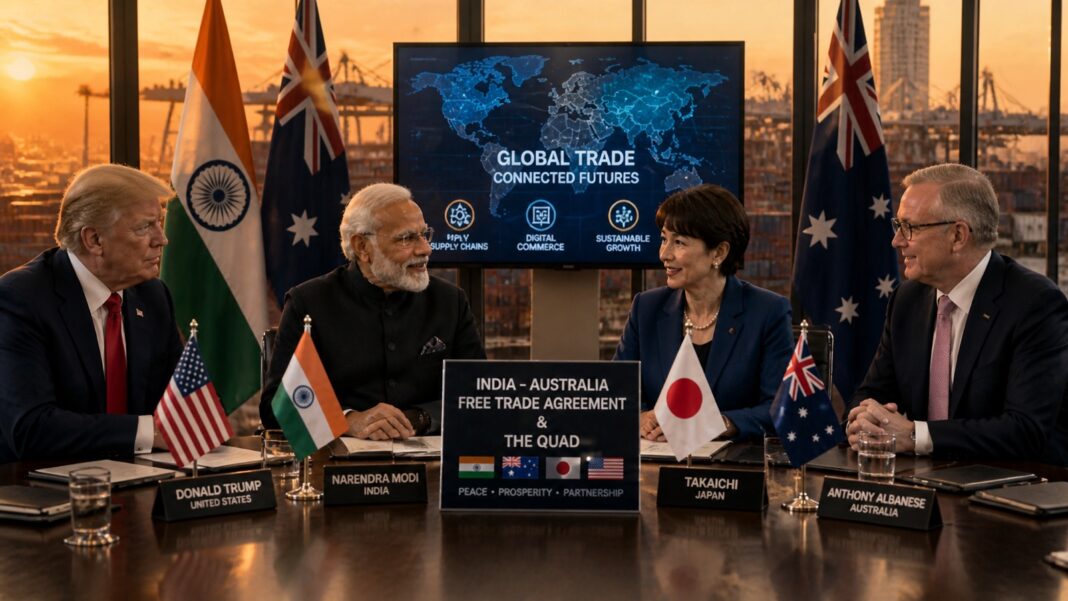
Australia released its 2026 National Defence Strategy in April 2026. The document addresses the need for a greater self-reliance, deterrence, sovereign Defence-Industrial resilience, national preparedness, more diverse supply chains and coordination with regional partners. These are the right words for a dangerous decade, which has seen serious conflicts emerging in our region, and impact us where it hurts (fuel costs)!
In this context, visit from Indian Prime Minister, Narendra Modi next week to Australia should not be treated as another routine bilateral engagement. If defence, trade, critical minerals (rare earths and uranium) and energy security are on the agenda, then this visit arrives at a far more important strategic moment than many in Canberra appear to recognise. Foreign Minister Penny Wong’s statements and announcement also hints the visit to address a more uncertain and disrupted regional environment, previously discussed at the Quad Foreign Ministers’ Meeting.
The AUKUS angle
But the real question one should ask ‘Is Australia prepared to convert those words into an independent regional strategy?’ Or will it continue to behave as if strategic seriousness begins and ends with Washington? That is the elephant in the room!
Australia does not need to abandon the United States. The US alliance remains central to Australian security, intelligence, technology and deterrence. AUKUS is necessary for high-end undersea capability and long-term military balance in the Indo-Pacific. The problem is not the alliance itself. The problem is that Canberra too often mistakes alliance management for grand strategy, as has been stated by our MPs like Andrew Hastie, Independents, and even some hushed voices within Labor party. A sovereign country can have powerful allies. But it cannot outsource its worldview.
Hence Modi’s visit should not be looked from a narrow angle of trade. It is not just about India reportedly seeking Australian uranium to support its expanding nuclear energy ambitions, driven in part by rising power demand from artificial intelligence, data centres and digital infrastructure. It is also about whether Australia can recognise India as an indispensable Indian Ocean partner, not merely as a trade market or diaspora relationship. Australian uranium exports to India are already possible under a civil nuclear cooperation framework, with DFAT stating that such exports are for peaceful purposes and subject to safeguards.
Business Trade and Regional Stability
Australia imports about 90% of its fuels as refined products, primarily from South Korea, Singapore and Malaysia. Lack of long-term strategic focus caused 6 of 8 refineries shut down over last 20 years, limiting the onshore refining capacity to about 230,000 barrels/day (bpd). India on the other hand, refines upto 5.4 million bpd. With the USA is addressing its decline in refining through India’s Reliance Industries’ 168,000 bpd refinery, the first refinery to be built there after 50 years. Australia can use a similar route to achieve greater sovereignty in this sector oer next few years. Similarly, Australia is 4th largest producer of uranium, a fuel that India and Japan need, as they increase nuclear reactors over next decades. Combined with rare earths (9% of globa production), this can set Australia on a greater strategic autonomy.
The strategic geography is clear. The conflicts and disruptions that matter the most to Australia are no longer confined to the South China Sea. The war in Ukraine, conflict in the Middle East, pressure on the Strait of Hormuz, attacks on Red Sea shipping, instability around the Horn of Africa, rare earth restrictions and supply-chain coercion all have consequences for Australian fuel, fertiliser, minerals, shipping, insurance, inflation and national resilience. The Quad Foreign Ministers’ Joint Statement itself referred to maritime disruptions, energy security, food and fertiliser security, critical minerals, economic coercion, and the importance of resilient supply chains.
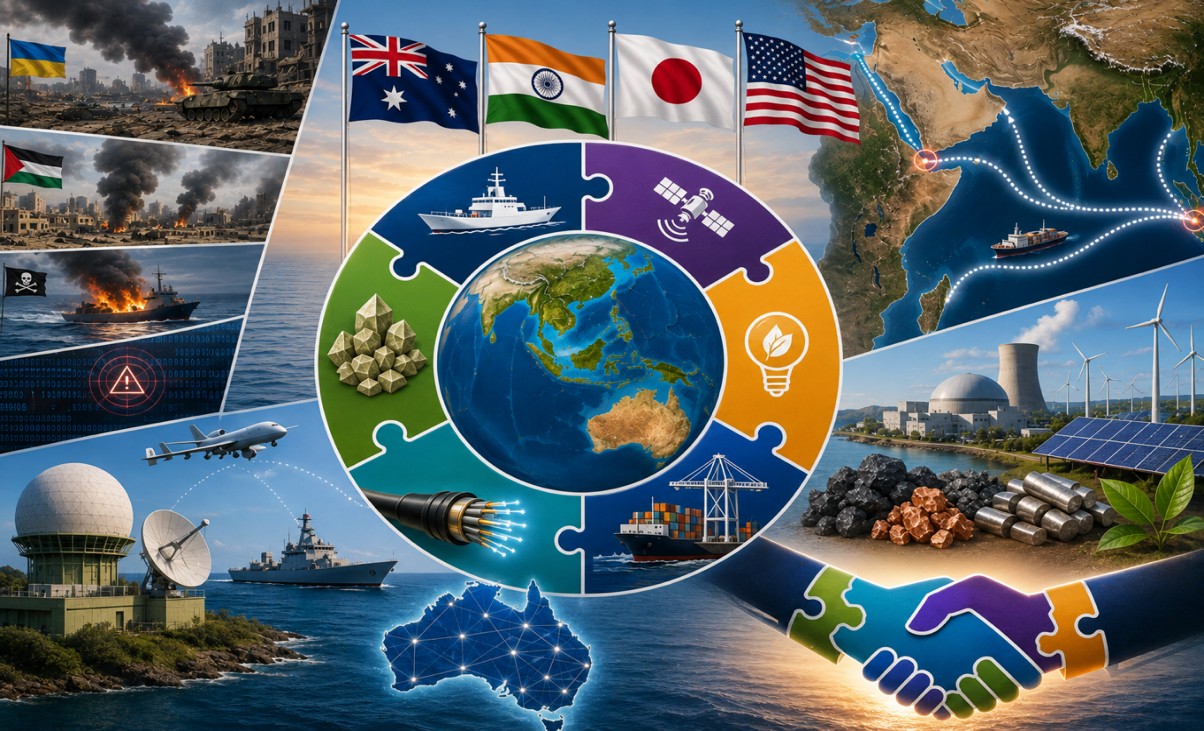
These pressures converge in the Indian Ocean. India sits at the centre of that theatre. Australia’s west coast faces it. Japan depends on it for energy routes. The United States needs partners who can share the burden rather than simply echo American preferences. Three of the four Quad members are therefore either Indian Ocean powers or directly exposed to Indian Ocean disruption. Yet Australia’s strategic debate remains disproportionately absorbed by AUKUS.
This imbalance must change. The Quad — Australia, India, Japan and the United States — should be brought back to the centre of Australian strategy, not as a replacement for AUKUS, but as its necessary regional complement.
The Quad
The Quad is often dismissed because it is not a formal alliance. But that is precisely why it is useful. India will not become a treaty ally of the United States. It will not behave like a NATO partner. It will act according to Indian interests. But that should not frighten Australia; it should mature Australia. The purpose of strategy is not to find a new patron. It is to build a network of partners whose interests overlap enough to create balance, resilience and room for manoeuvre.
The recent Quad agenda already shows the way forward. The Quad Foreign Ministers’ Meeting in New Delhi announced practical initiatives across maritime surveillance, maritime domain awareness, critical minerals, energy security, ports and undersea cable resilience. These priorities map directly onto Australia’s vulnerabilities. They are not abstract diplomatic slogans. They are the operating system of twenty-first century power.
The counterargument is obvious. AUKUS offers clearer military deterrent value than the Quad. The United States remains the only partner able to provide Australia with the highest levels of intelligence, technology and military reach. India is strategically autonomous, sometimes difficult, and unwilling to be locked into anyone else’s bloc. These concerns are real.
But they strengthen the argument rather than weaken it. A mature Australia should not place all its strategic weight on one alliance, one technology pathway, or one patron. It should use AUKUS for high-end deterrence, the Quad for regional resilience, and the India relationship for Indian Ocean depth.
The impending visit of Indian PM
Indian PM Narendra Modi’s visit, especially on the backdrop of India-Japan UNICORN and other co-development joint-pacts (e.g. New Zealand), should therefore be used to anchor a serious Australia–India–Quad compact around these priorities. This visit can become more than a conversation about uranium, trade or diaspora warmth. It can become the moment Australia starts thinking like a sovereign Indo-Pacific power with an Indian Ocean future.
Australia does not need to choose between Washington and New Delhi. It needs to stop behaving as though Washington alone defines its strategic imagination. If AUKUS gives Australia reach, the Quad can give Australia depth. And without depth, reach is not strategy; it is dependence with better hardware.
References
- Australian Government Department of Defence. “2026 National Defence Strategy and 2026 Integrated Investment Program.” Department of Defence, 2026.
- Australian Government Department of Defence. “Preparing Australia for future strategic challenges.” Department of Defence, 17 April 2026.
- Wong, Penny. “Press conference, New Delhi, India.” Minister for Foreign Affairs, Australian Government, 26 May 2026.
- Wong, Penny. “Quad Foreign Ministers’ Meeting Joint Statement.” Minister for Foreign Affairs, Australian Government, 26 May 2026.
- Wong, Penny. “Factsheet: Quad Foreign Ministers’ Meeting in New Delhi, May 2026.” Minister for Foreign Affairs, Australian Government, 26 May 2026.
- Australian Mining. “India’s AI boom could fuel Australian uranium demand.” Australian Mining, 11 June 2026.
- Jason The. The refinery problem: A different kind of energy crisis in 2026. Morningstar. 2 April 2026.
- Nathan Schmidt. ‘A disgrace’: Why Australia’s oil refineries were shuttered before Geelong fire. News.com.au. 16 April 2026
- CNBC. Trump says U.S. will build first refinery in 50 years with investment from India’s Reliance Industries. 10 March 2026
- Department of Foreign Affairs and Trade. “Australia’s network of nuclear cooperation agreements.” Australian Government.
- Jenny Bloomfield. Can rare earths be Australia’s next mining boom? Lowy Institute. 22 October 2025
- Sydney Morning Herald. “Modi wants Australia’s uranium to power India’s data cent October re boom.” The Sydney Morning Herald, 10 June 2026.
- Prime Minister of Australia. “2nd India-Australia Annual Summit.” Prime Minister of Australia, 20 November 2024.
- Department of Foreign Affairs and Trade. “India country brief.” Australian Government.