


Author: Parimal
X: @Fintech03
Email: fintech03X@gmail.com
We live in an era paralysed by behavioural traps. Despite an explosion of self-help books, biohacking apps, & mental health trends, humanity feels more enslaved to habits, addictions, & generational trauma than ever before. We consciously decide to rewrite our lives on a Monday, only to find our brains automatically executing the exact same toxic behavioural loops by Wednesday.
Modern neurology explains this via neural plasticity: the physical grooving of synaptic pathways in the brain. Epigenetics explains it as environmental markers turning specific gene expressions on/off.
But if we strip away the contemporary biological jargon & look at the core psychological architecture mapped out in the Yoga Sutras & Vedanta, the ancient riShis did not treat behavioural patterns as fluid emotional mysteries. They treated them as a strict Version Control System.
Our subconscious mind is a biological repository, & our habits are a Recursive Git Commit Loop hardcoded into our neural network.
Act I: The Karma-Samskara-Vasana Pipeline as a Git Repository
To understand why we cannot easily change our behavior, we must look at how our mental source code is compiled. In Indian psychology, our mind is not a blank slate; it is a repository (Chitta) running a continuous integration/continuous deployment (CI/CD) pipeline.
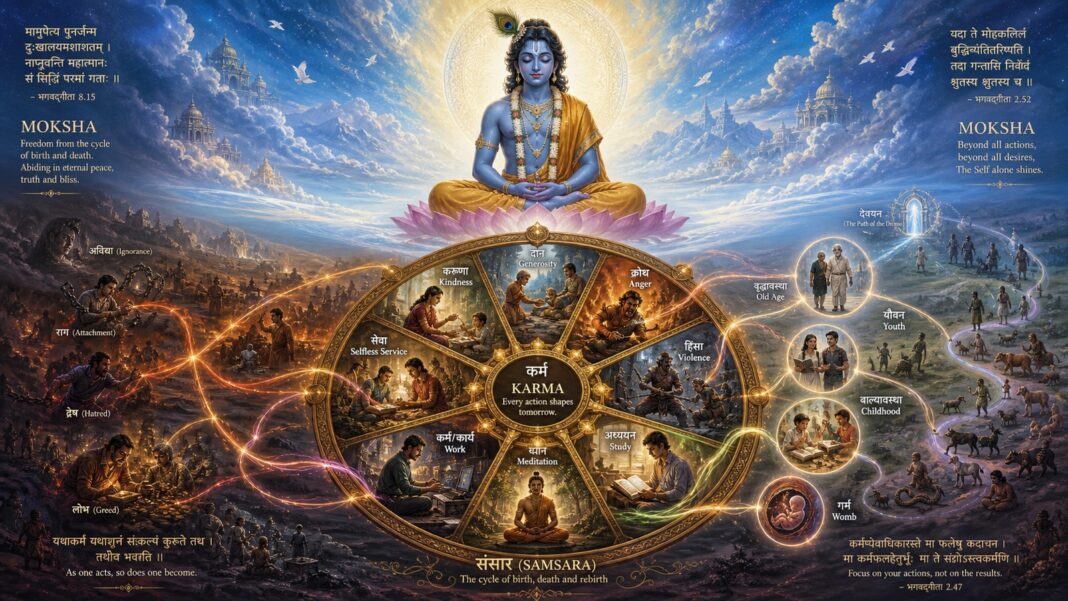
This pipeline operates on a deterministic 3 stage loop: Karma (Action) → Samskara (Impression) → Vasana (Tendency).
Let us translate this directly into modern software engineering terminology:
1. The Git Commit (git commit -m “Action”) = Samskara
Every single time we execute an action/speak a word/harbor a specific thought, our neural hardware fires a synaptic sequence. In Patanjali’s framework, this behavioral execution leaves behind a Samskara: a subtle, digital fingerprint in the subconscious memory layer.
A Samskara is a literal code change log. It is the equivalent of running:
bash
git commit -m “Executed anxious response to external criticism”
2. The Main Branch Merge (git merge) = Vasana
A single commit does not change the entire software architecture. But if we repeatedly commit the exact same code block day after day, those individual Samskaras cluster, consolidate, & merge directly into our production environment’s main branch.
This consolidated cluster becomes a Vasana: a deeply grooved, latent behavioral tendency. In computer science, a Vasana is a pre-compiled script file sitting in our system’s bin directory, waiting for a specific environment variable (a trigger) to execute automatically.
3. The Runtime Dependency = Karma
When an external event occurs, our brain does not think from scratch; it takes the path of least resistance. It calls the pre-compiled Vasana script. The script runs, producing an automated action (Karma), which in turn creates a brand new Samskara (Commit).
We are not operating on free will; we are caught in a Recursive Git Loop where old commits are automatically writing the code for our future deployments.
Act II: Generational Trauma & the Forked Upstream Repository
The problem cuts deeper than our own lifetime. Many of our deepest anxieties, triggers, & behavioral bugs do not even belong to our current timeline. Modern science calls this Epigenetic Inheritance: the transmission of trauma markers down the ancestral bloodline. In the Dharmic framework, this is the foundational architecture of the Sanchita Karma registry. When we are born, we do not start with a clean, empty directory. We are cloning a heavily modified, forked upstream repository from our ancestral lineage.
bash
git commit -m “Executed anxious response to external criticism”
Our ancestors’ unresolved survival threats, famines, wars, & behavioral coping mechanisms are passed down as latent codebase configurations. We inherit a system where certain emotional firewalls are already down, & certain alarm systems are tuned to hyper-sensitivity.
When we experience an irrational panic loop as an adult, we are not experiencing a new system error; we are executing an inherited, legacy bug that was committed to the upstream repository 3 generations ago.
Act III: Rewriting Git History via Abhyasa & Kriya
Most self-help advice fails because it operates at the application layer (conscious willpower). Trying to stop a deep-seated addiction/anxiety loop using raw willpower is like trying to change a core database entry by typing on a disconnected monitor. The pre-compiled Vasana script bypasses the conscious UI entirely.
To change the system, we must drop into the terminal, initialize a root-level override, & Force-Rewrite the Git History.
Patanjali provides the exact technical command for this in Yoga Sutra 1.12: Abhyasa-vairagyabhyam tan-nirodhah (The suppression of these software fluctuations is achieved through deliberate practice and detachment).
1. git rebase -i (The Abhyasa Protocol)
Abhyasa is not just casual repetition; it is defined as continuous, uninterrupted, high-intensity deliberate effort over a prolonged timeline.
In terms of neural plasticity, when we consciously refuse to execute an automated habit loop despite an intense craving, we are triggering an internal Merge Conflict. Our system wants to run the cached Vasana script, but we intercept the execution thread. By introducing a new, deliberate action (Kriya), we are executing an interactive rebase. We are going back into the historic commit logs & systematically overwriting old, corrupt entries with clean, functional code blocks.
2. git commit –amend (The Kriya Reset)
Kriya refers to deliberate, purifying actions designed to exhaust the latent energy of stored impressions. When an old trauma/trigger surfaces, instead of allowing it to execute its standard runtime loop (anger, escape, numbing), we hold the space & process the biological sensation w/o reaction (Vairagya).
By detaching the emotional charge from the memory, we run:
bash
git commit –amend -m “Trigger received; system remained stable”
We have effectively stripped the malicious payload from that historic Samskara. The next time the system calls that specific index file, the automated payload fails to detonate.
Act IV: System Hard Reset (git reset –hard) = Moksha
As long as there are active branches & historical commit logs left in the subconscious repository, the machine will continue to cycle through life, death, habit, & reaction. Every human being is a walking bundle of historical code execution.
The ultimate goal of the Dharmic spiritual architecture is not to merely write “good code” instead of “bad code.” The goal is the absolute cessation of the loop: Moksha (Liberation).
In computer science, when a repository becomes so terminally corrupted & bloated with legacy dependencies that it can no longer be salvaged, we do not run an update. We perform a complete wipe.
Moksha is the ultimate, cosmic Hard Reset. Through the fire of absolute, non-dual awareness (Jnana), the underlying storage medium itself is demagnetized. The historical logs (Sanchita) are erased, the active mempool (Agami) is aborted, & the biological processor is liberated from the version control system entirely.
- We are not a broken, weak-willed victim of our habits/our ancestry. We are simply a biological computer executing the exact scripts that have been committed to our repository over cycles of time.
- The realization that our habits are just pre-compiled Vasanas is the 1st step toward systemic liberation. We do not need to fight our past; we need to audit our terminal. Every conscious choice we make in the present moment, every time we pause, breathe, & refuse to react to an old trigger is a fresh, clean code injection.
- Stop letting legacy software run our modern hardware. Access the root directory, intercept the CI/CD pipeline, & start rewriting our history 1 commit at a time.
References:
- Edwin F. Bryant, The Yoga Sutras of Patañjali: A New Edition, Translation, and Commentary (North Point Press, 2009)
- https://pmc.ncbi.nlm.nih.gov/articles/PMC10220233/
- https://www.academia.edu/5373904/Theories_of_Karma_A_Comprehensive_Survey_INTRODUCTION