

Harmony Without Uniformity, With Dignity
What an ancient Indian ideal can teach us about living with difference — and why the test of unity is how we treat those who disagree.
A New York gathering, and the question behind it
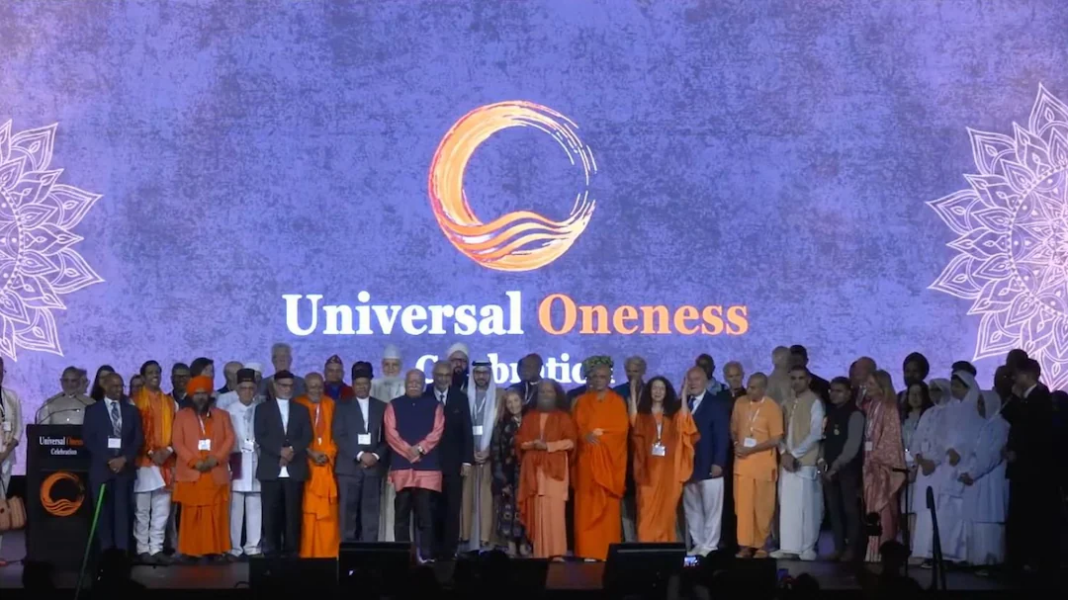
The images from the Universal Oneness Celebration at Madison Square Garden in New York offer a striking visual expression of an ancient Indian ideal: Vasudhaiva Kutumbakam — “the world is one family.” The event, held on 29 August 2026 and organised by the American Hindus for Engagement and Dialogue (AHEAD) Forum, brought together a large audience and participants from different religious and cultural backgrounds. Its central message was that people need not become identical to stand together.
That distinction matters. The people on the stage represented different faiths, cultures, nations, traditions and ways of life. Their clothing, symbols, languages and practices remained visibly different. Yet they shared a platform around ideas of human dignity, responsibility and peace. The image therefore communicates something deeper than simple togetherness: unity can be built without erasing difference.
The meaning of Vasudhaiva Kutumbakam
The expression Vasudhaiva Kutumbakam comes from the mahā upaniṣad:
अयं निजः परो वेति गणना लघुचेतसाम् ।
उदारचरितानां तु वसुधैव कुटुम्बकम् ॥
ayaṃ nijaḥ paro veti gaṇanā laghucetasām; udāracaritānāṃ tu vasudhaiva kuṭumbakam.
“It is the narrow-minded who distinguish between ‘this is mine’ and ‘that is another’s’;
for the broad-minded, the whole world is one family.”
This is not merely a poetic statement. It is an ethical vision. It asks us to expand our circle of concern beyond family, community, religion, nationality and ideology, and to recognise that the wellbeing of others is connected to our own.
To regard the world as one family does not mean pretending that everyone thinks alike. Families themselves contain disagreement, different personalities, varied beliefs and competing aspirations. What makes a family a family is not uniformity, but relationship, care, responsibility and the willingness to resolve differences without destroying one another.
Unity in diversity
The gathering shown in the images embodies the principle of unity in diversity. The participants do not appear to have abandoned their individual identities. On the contrary, their distinctive attire and traditions remain visible. Their unity arises from a higher commitment: the belief that diversity can be a source of learning rather than suspicion.
A society becomes richer when different traditions contribute their insights. One community may emphasise compassion, another service, another contemplation, another justice, and another stewardship of nature. When these values meet in a spirit of humility, they can strengthen one another.
Unity in diversity is therefore not a compromise in which everyone gives up what makes them distinctive. It is a shared space where differences are acknowledged, respected and placed within a wider commitment to human flourishing.
Harmony does not require uniformity
There is an important distinction between harmony and uniformity.
Uniformity demands sameness. It suggests that peace is possible only when people share the same beliefs, practices, appearance, language or worldview. Such an approach may produce outward conformity, but it can also suppress individuality and turn difference into a threat.
Harmony, by contrast, allows distinct voices to coexist. In music, harmony is created when different notes sound together. If every instrument played the same note at the same pitch, there might be volume, but there would be little richness. Harmony depends on difference being held together by rhythm, balance, listening and proportion.
Human society is similar. We do not need identical beliefs to share a commitment to non-violence. We do not need the same rituals to defend the dignity of every person. We do not need one culture to appreciate the wisdom of another. What we need is the discipline to disagree without hatred and to protect one another without demanding sameness.
A rejection of hatred
The message associated with the gathering argues that religion must not be used to justify hatred, humiliation, dehumanisation or violence. That principle is crucial. Faith can inspire compassion, courage, service and moral responsibility; but when religious identity is used to deny another person’s humanity, it contradicts the very values it claims to defend.
The call to stand with any community threatened by humiliation or violence is especially significant. Solidarity cannot be selective. If dignity is defended only when one’s own group is affected, it is not yet universal. The spirit of Vasudhaiva Kutumbakam asks us to oppose cruelty because cruelty diminishes the whole human family.
This does not require us to erase legitimate differences or avoid difficult conversations. It requires us to conduct those conversations without contempt. Dialogue is meaningful only when the other person is regarded as fully human, even when their beliefs differ from our own.
From symbolism to responsibility
A gathering of leaders is valuable not simply because it creates an inspiring photograph, but because it can encourage action. The idea of universal oneness has meaning only when it extends beyond ceremonial occasions into everyday conduct.
- refusing to spread stereotypes about another faith or community;
- protecting minorities from intimidation and discrimination;
- teaching children the difference between disagreement and hatred;
- serving vulnerable people regardless of identity;
- addressing poverty, war, displacement and environmental destruction as shared human concerns;
- creating spaces where religious and cultural communities can meet as equals.
The responsibility is both collective and personal. Governments, institutions, religious organisations, schools, workplaces and individuals all have a role in creating a culture where difference is not feared.
The New York gathering — and the debate around it
The event also became the centre of a political and cultural dispute because its keynote speaker was Dr Mohan Bhagwat, Sarsanghachālaka, or chief, of the Rashtriya Swayamsevak Sangh (RSS). Bhagwat was in New York as part of a three-country outreach tour during the RSS centenary year. The event was presented by its organisers as an interfaith and cultural celebration, while critics argued that the RSS’s ideology and record make its invocation of “oneness” deeply contested. New York Mayor Zohran Mamdani said he did not support the event and described the RSS’s vision as exclusionary, while also noting the limits on the city’s ability to cancel a private programme.
The historical record around the RSS is more precise than the broad claims sometimes made in this debate. No allegations have been proven in any court of law. These facts, however, do not satisfy the ideological opponents or the larger argument the critics voice about the RSS. Supporters point to its extensive volunteer and relief work in its hundred-year history, while critics point to its Hindu-nationalist ideology and doubts concerning the treatment of religious minorities.
The real useful question today is whether a public language of oneness is matched by a willingness to respect people who remain different. That is the standard by which the philosophy of Vasudhaiva Kutumbakam can be taken seriously: not as a slogan that ends disagreement, but as an ideal that asks how disagreement is handled.
One truth, One world, many paths
एकं सत् विप्रा बहुधा वदन्ति
ekam sat viprā bahudhā vadanti
Truth (or That which Exists) is One; the wise call it by many names.(Ṛgveda)
The stage at Madison Square Garden can be understood as a living metaphor. Many paths led the participants there, but they shared one platform. Their traditions remained distinct, yet they could stand together. This is the promise of Vasudhaiva Kutumbakam: not one path, one language or one identity, but one human family enriched by many paths.
The world does not need to become a single colour to be beautiful. A garden is not harmonious because every flower is the same; it is harmonious because different flowers grow together. Likewise, humanity’s future will depend not on uniformity, but on our capacity to combine diversity with empathy, freedom with responsibility, and conviction with humility.
The deepest unity is not the absence of difference. It is the presence of respect across difference.
Vasudhaiva Kutumbakam therefore remains both an ancient teaching and a contemporary challenge: to see beyond the boundaries that divide us, to defend the dignity of every community, and to build a world in which harmony does not demand sameness.
This is the message the world needs to take home from this event “Universal Oneness”.