

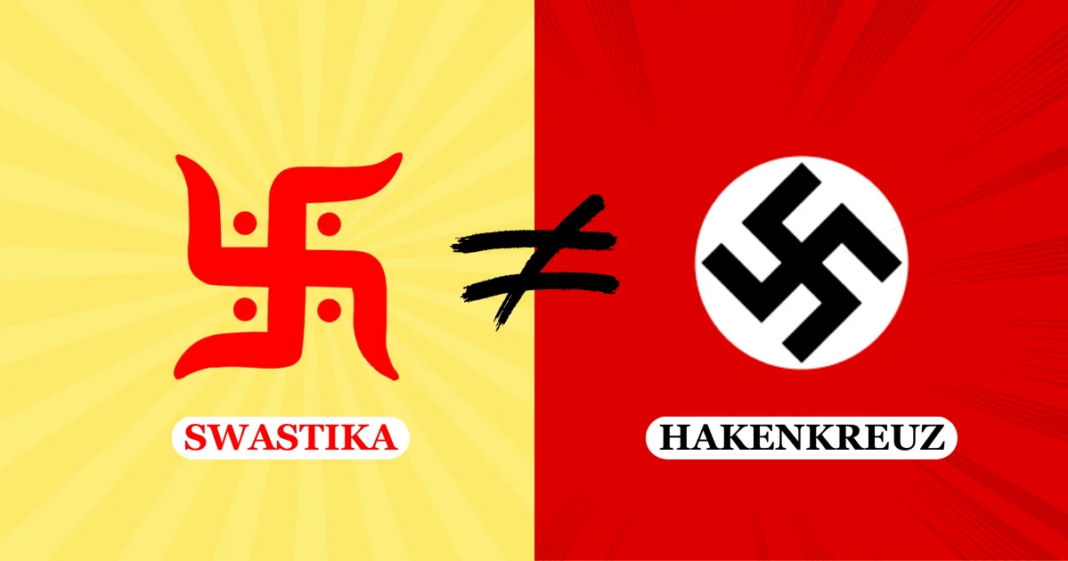
How a sacred symbol was conflated with the Nazi Hakenkreuz and how it is being reclaimed
The Nazis did not speak Sanskrit, and in Mein Kampf Hitler did not call his emblem a “swastika”. He called it the Hakenkreuz, the “hooked cross”. So how did a sacred symbol, used for thousands of years in the temples, homes and festivals of Hindus, Jains and Buddhists, come to be treated in the English-speaking world as the name and image of Nazi hatred?
The answer is part history, part language. It also shows what a single word choice can cost, and how communities can correct the record without diminishing the memory of the Holocaust.
The Sacred Swastika is not the Hateful (Nazi) Hakenkreuz
Part One: How the Symbols Were Conflated
A Symbol Older Than History
The Sanskrit word svastika (स्वस्तिक) comes from su, meaning good, and asti, meaning being or existence. It expresses auspiciousness, well-being and good fortune [1]. Its four arms denote the 4 principal Vedas (R̥g, Sāma, Atharva, and Yajur), seasons, and stages of life.
Different versions of the symbol appear across many ancient cultures. The United States Holocaust Memorial Museum notes that it was in use thousands of years before Adolf Hitler adopted the hooked cross for the Nazi flag in 1920 [1]. In Hinduism, Jainism and Buddhism it is not an archaeological relic. It is a living religious symbol.
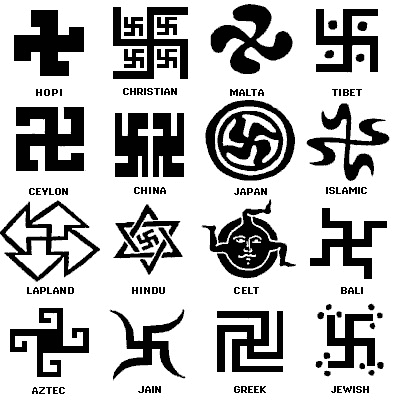
Swastika-like motifs across world cultures
A European Detour
The trouble began in nineteenth-century Europe. Scholars and nationalist movements linked ancient symbols and archaeological finds to supposed racial identities. Racist movements then used these theories to support myths of “Aryan” racial superiority [1]. A sacred Hindu symbol was being drawn into European racial myth well before the Nazi Party existed.
The Nazis Called It a Cross
The Nazi Party made the hooked cross the centre of its political identity. In 1920 it adopted its flag: a black hooked cross in a white disc on a red background [1]. Hitler described the design in Mein Kampf as “a red background, a white disc, and a black Hakenkreuz in the centre” [1].
The name matters. Germany in the 1930s and 1940s was overwhelmingly Christian, with about 95% of the population identifying as Protestant or Catholic. The Nazis’ emblem was named as a cross, and it sat within a wider German tradition of cross symbols. The ordinary German word for the Nazi emblem is Hakenkreuz [1]. Both the perpetrators and the victims of Nazism knew the symbol of persecution as the hooked cross.
English translators have rendered the regime’s other crosses accurately. The Eisernes Kreuz is the Iron Cross. The Ritterkreuz is the Knight’s Cross of the Iron Cross. The Balkenkreuz, the “bar cross” marking the Wehrmacht’s army, air force and navy, traces its lineage to the cross of the Teutonic Order. Only the Hakenkreuz lost its name in mistranslation.
How “Swastika” Became the English Word
The substitution happened in the English-language press long before it reached any translated book. The Sanskrit word had entered English in the nineteenth century, partly through the American Transcendentalists’ interest in Hindu thought. The Bhagavad Gita influenced writers such as Ralph Waldo Emerson and Henry David Thoreau. When the Nazi movement emerged, journalists already had a fashionable word available [1].
As Salvatore Babones of the Indian Century Roundtable has documented [7]:
- 15 April 1920: the London Daily Telegraph used “swastika” for the hooked cross in a report on the Ehrhardt Brigade.
- 10 February 1921: The New York Times first linked the “swastika” to the Nazis.
- July 1922: Reuters described the “swastika” as an antisemitic emblem.
- From January 1923: The Times, the Daily Telegraph and The New York Times all used the word regularly for the symbol of Hitler’s party. The New York Times kept doing so throughout the decade [7].
Book translations then made the press usage official. E.T.S. Dugdale began an abridged English translation of Mein Kampf in 1931, but it was not published until October 1933 [14]. It rendered Hakenkreuz accurately as “hooked cross”. In March 1939 James Vincent Murphy, an Irish journalist and former Catholic priest, published the first complete British translation [14]. Despite his fluency in German, Murphy translated Hakenkreuz as “swastika”. His was the version that reached a mass English-language readership.
After the Second World War, New York became the centre of global media, and the press’s 1920s habit became fixed in English [7]. For decades nobody corrected the record.
Part Two: The Consequences of the Conflation
A Sacred Symbol Became Collateral Damage
After the Nazis took power in 1933, the hooked cross was everywhere in German public life. It came to stand for a regime responsible for aggressive war, systematic persecution and the Holocaust: the murder of six million Jews, together with the persecution and murder of millions of other victims [1]. Its power to cause fear and grief is real, and it endures.
Because English used one word for two different things, the sacred swastika became conflated with that horror too. The Nazi emblem and the ancient religious symbol now shared one name, and the sacred symbol became collateral damage.
Living With the Misunderstanding
For Hindu, Jain and Buddhist families around the world, this has had concrete effects:
- A swastika at a temple entrance, on a doorway at Diwali or on a wedding invitation can be mistaken for extremism.
- Families and community organisations have had to explain their own worship to neighbours, schools, employers and media who know the word only through its Nazi association.
- As governments rightly move to ban Nazi symbols, a law that does not separate the two criminalises peaceful religious practice.
These are not abstract concerns. The swastika is central to everyday Hindu devotion. It is drawn in kumkum or turmeric on thresholds, ceremonial vessels, account books and offerings. It appears during puja, at Diwali, at weddings and at other important life events, as well as in temple art and architecture [2]. It holds an important place in Jain symbolism too, and in Buddhism it marks auspiciousness in art and iconography [1].

A family draws the swastika at the threshold during a festival

The swastika on a kalash prepared for puja
Holding Two Truths
Any honest response has to hold two truths together. First, the Hateful Nazi Hakenkreuz carries an undeniable history of hatred and genocide. Second, the Sacred Swastika has an ancient religious identity that has no connection to Nazism. The campaign described below has succeeded because it holds both.
Part Three: Reclaiming the Swastika
Building a Coalition
No single organisation or declaration has reclaimed the Swastika. Hindu organisations have led the work through education, interfaith dialogue, community advocacy and engagement with lawmakers. Buddhist and Jain representatives, scholars, community leaders and Jewish partners have worked alongside them.
The Hindu American Foundation (HAF) has played a prominent educational role, as has the Coalition of Hindus of North America. Locally, the Hindu Council of Australia has taken the lead. All have produced resources that explain the sacred Swastika’s religious significance and challenged attempts to criminalise it by conflating it with Nazi symbology [2].
Hindu–Jewish Dialogue
A key milestone came in 2008. The Second Hindu–Jewish Leadership Summit adopted a resolution distinguishing the sacred Hindu swastika from its Nazi misappropriation. The resolution showed that protecting Hindu religious expression is compatible with honouring Jewish suffering and opposing antisemitism.
That principle later shaped HAF’s work with the Anti-Defamation League (ADL), a leading Jewish civil-rights organisation. In August 2022 the two organisations co-hosted a webinar for an interfaith audience. At the invitation of the bill’s author, they also gave joint testimony to the California State Senate in support of AB 2282 [6].
California: The Hakenkreuz Enters the Penal Code
Governor Gavin Newsom signed AB 2282 on 18 September 2022 [5]. Its main purpose was to equalise penalties for hate crimes involving nooses, burning crosses and Nazi symbols displayed to terrorise people. However, it also wrote a significant distinction into the California Penal Code [11]. The law states that it targets “the Nazi Hakenkreuz (hooked cross)” and that it is “not intended to criminalize” the ancient swastika symbols associated with Hinduism, Buddhism and Jainism, which it calls “symbols of peace” [11].
The result was a partial victory. The law still uses the phrase “Nazi swastika”. HAF called this a stopgap required by existing legal drafting [12]. Other groups, including the Coalition of Hindus of North America (CoHNA) and Buddhist leaders in New York, argued that it continued to imply a “good swastika” and a “bad swastika” [13]. The disagreement showed how far the debate had moved. The question was no longer whether to distinguish the symbols, but how precisely to name them.
Australia: From Explicit Protection to Precise Language
Australia has gone further. Victoria’s ban on the Nazi symbol took effect on 29 December 2022. The Victorian Government explicitly distinguishes the Nazi Hakenkreuz from the sacred Swastika. Its public guidance says genuine religious and cultural displays in homes, temples, ceremonies and celebrations remain lawful [4]. New South Wales legislated in the same year via the Crimes Amendment (Display of Nazi Symbols) Act 2022, providing that displaying a swastika in connection with Buddhism, Hinduism or Jainism is not displaying a Nazi symbol [9].
In Queensland, where prohibition measures took effect on 29 April 2024 under the Summary Offences and Other Legislation Amendment Act 2023, law safeguards traditional usage via a statutory defense for authentic devotional practices rather than an explicit exception. Official Explanatory Notes clarify that this protection intentionally encompasses the sacred Swastika revered within Hindu, Buddhist, and Jain traditions [10].
At the federal level, the Senate inquiry into the Criminal Code Amendment (Prohibition of Nazi Symbols) Bill 2023 considered concerns from faith communities. These included religious freedom, statutory terminology and the risk of unintended effects on Hindu, Buddhist and Jain Australians [3]. That bill did not pass in its original form. Instead, Parliament enacted the Counter-Terrorism Legislation Amendment (Prohibited Hate Symbols and Other Measures) Act 2023 [8]. That Act names the prohibited symbol as “the Nazi hakenkreuz” and protects display for genuine religious purposes [8].
The Attorney-General’s Department explained that the Act uses “hakenkreuz” rather than “swastika” because the sacred swastika is “an ancient symbol of peace and good fortune” [15]. Hindu advocates had asked for exactly this kind of linguistic precision. In Australia it now appears in national criminal law, not only in community advocacy.
Reclaiming the Word
Alongside legal reform, a broader campaign is underway to correct the language itself. Babones argues that the confusion is less about the image than about the word. Those who want to prohibit Nazi symbols should therefore call the Nazi emblem by its proper name. If Hakenkreuz seems unfamiliar to anyone, then the “hooked cross” is an accurate English alternative [7].
“If our ancestors could learn a little Sanskrit to describe a symbol of peace, we can learn a little German to describe a symbol of hate.” — Salvatore Babones [7]
What Has Been Achieved, and What Remains
The campaign has made real progress:
- Recognition: the Swastika is increasingly treated as a living religious symbol, not merely an artefact or a Nazi image.
- Law: California’s Penal Code and Australia’s federal, Victorian and New South Wales laws now distinguish the Sacred Swastika from the Nazi emblem. Australia’s federal law names that emblem the Hakenkreuz.
- Education: resources from HAF, CoHNA and HCA have explained the symbol’s history to audiences unfamiliar with Hindu, Jain and Buddhist religious traditions.
- Interfaith partnership: Hindu–Jewish cooperation, from the 2008 summit to joint work with the ADL, shows that defending the sacred swastika and fighting antisemitism are compatible goals.
- Language: commentators increasingly point out that the Nazis called their emblem the Hakenkreuz, and that “swastika” was largely the choice of English-language newspapers in the 1920s, like the New York Times [7].
- Standing: Hindu communities now have stronger grounds to challenge depictions of their religious practice as Nazi ideology.
The work is not finished. Public understanding is uneven, legal protection differs between jurisdictions, and many media outlets, museums and educational institutions still call the Nazi emblem a “swastika”. Appearance alone cannot settle meaning, either. Context, purpose, presentation and the applicable law still determine whether a display is religious expression or extremist propaganda.
Reclaiming The Meaning Without Erasing History
Since the 2008 Hindu–Jewish Leadership Summit, steady education, dialogue and engagement with governments have changed how lawmakers in California and Australia name and treat these two symbols. Declaring the struggle won would still be premature.
The lesson is not that the history of the hooked cross should be softened or forgotten. It is the reverse. Calling the Nazi emblem by its own name, Hakenkreuz, keeps responsibility for it with the regime that chose it. It also returns the swastika to the Hindu, Jain and Buddhist communities for whom it has always meant well-being, auspiciousness and good fortune.
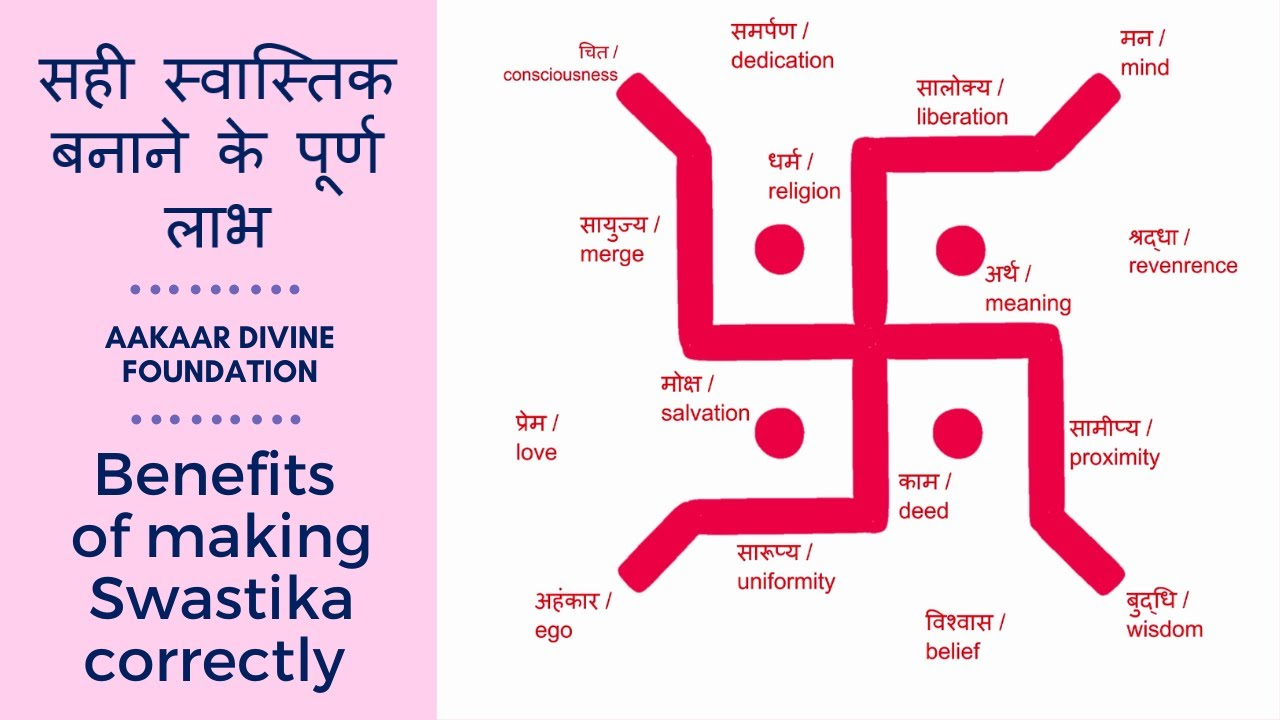
The meanings within the sacred swastika
The Sacred Swastika represents an ancient, shared cultural inheritance. The hateful Hakenkreuz or hooked cross was a deliberate choice by the perpetrators of genocide.
References
- United States Holocaust Memorial Museum. The History of the Swastika. https://encyclopedia.ushmm.org/content/en/article/history-of-the-swastika
- Hindu American Foundation. All About the Swastika. https://www.hinduamerican.org/learn-about-the-swastika/
- Parliament of Australia. Criminal Code Amendment (Prohibition of Nazi Symbols) Bill 2023, Senate Legal and Constitutional Affairs Committee Report. https://www.aph.gov.au/Parliamentary_Business/Committees/Senate/Legal_and_Constitutional_Affairs/SymbolProhibition2023/Report
- Victorian Government. About the Nazi Symbol and Gesture Ban. https://www.vic.gov.au/about-the-nazi-symbol-gesture-ban
- Governor of California. Governor Newsom Signs Legislation to Crack Down on Hate Crimes, Protect Targeted Communities, 18 September 2022. https://www.gov.ca.gov/2022/09/18/governor-newsom-signs-legislation-to-crack-down-on-hate-crimes-protect-targeted-communities/
- Hindu American Foundation. HAF and ADL Partner to Educate Community on Impact of California AB 2282, 11 August 2022. https://www.hinduamerican.org/press/haf-adl-webinar-california-ab2282
- Babones, S. The Swastika and the Hakenkreuz: How the New York Times Turned a Hindu Symbol of Peace into a Nazi Symbol of Hate. Indian Century Roundtable. https://www.indiancentury.org/community-briefs/swastika-hakencreuz-new-york-times
- Parliamentary Library (Australia). Bills Digest: Counter-Terrorism Legislation Amendment (Prohibited Hate Symbols and Other Measures) Bill 2023. https://www.aph.gov.au/Parliamentary_Business/Bills_Legislation/bd/bd2324a/24bd022
- Crimes Amendment (Display of Nazi Symbols) Act 2022 (NSW). https://legislation.nsw.gov.au/view/html/inforce/current/act-2022-040
- Queensland Legislation. Summary Offences and Other Legislation Amendment Act 2023 (Explanatory Notes). https://www.legislation.qld.gov.au/view/pdf/bill.third.exp/bill-2022-017
- California Penal Code, § 11411 (as amended by AB 2282, Stats. 2022, ch. 397). https://leginfo.legislature.ca.gov/faces/codes_displaySection.xhtml?lawCode=PEN§ionNum=11411
- Hindu American Foundation, via Hinduism Today. FAQs About California Legislative Bill AB2282 About the Swastika, 4 June 2022. https://www.hinduismtoday.com/hpi/2022/06/04/faqs-about-california-legislative-bill-ab2282-about-the-swastika/
- Hinduism Today. Hindu and Buddhist Groups Express Strong Disappointment Regarding California Assembly’s Passage of Bill AB2282 on Swastika, 29 May 2022. https://www.hinduismtoday.com/hpi/2022/05/29/hindu-and-buddhist-groups-express-strong-disappointment-regarding-california-assemblys-passage-of-bill-ab2282-on-swastika/
- Mein Kampf in English. Wikipedia. https://en.wikipedia.org/wiki/Mein_Kampf_in_English
- Attorney-General’s Department. Submission 16 to the Parliamentary Joint Committee on Intelligence and Security inquiry into right-wing extremist movements in Australia. https://www.aph.gov.au/DocumentStore.ashx?id=29afceca-05fc-4512-8f05-45c78461dbda&subId=753987