


Introduction: The Australian Census
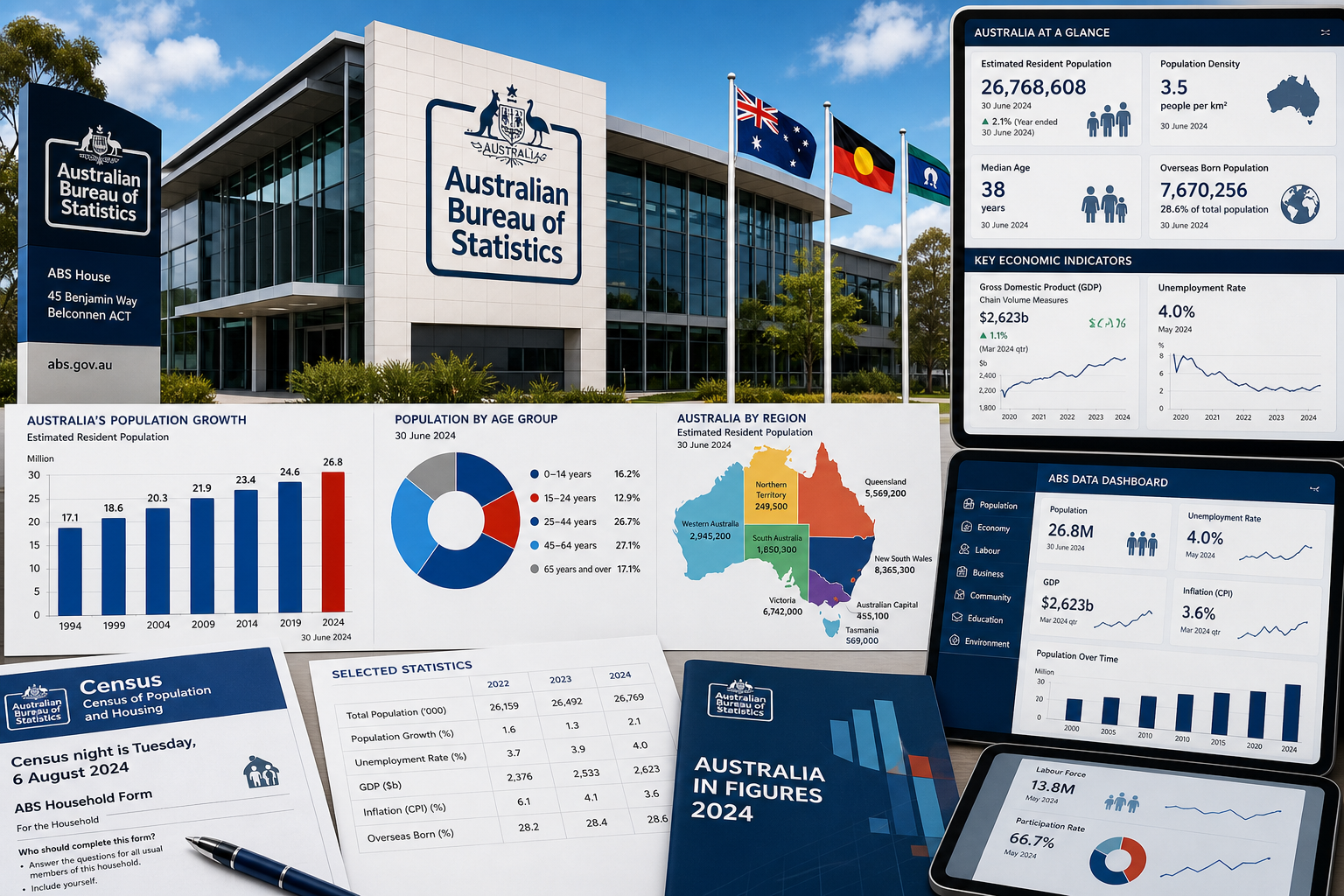
As per the Australian Bureau of Statistics (ABS), [The] Census is the most comprehensive snapshot of the country and tells the story of how [Australia] is changing.[1] Every five years, in the Census, the ABS collects information from people, like a survey.1 However, in this survey everyone, whole Australia, participates and answers the questions. [The] ABS counts every person and household in Australia.1 This includes Fly-In-Fly-Out (FIFO) workers, defence personnel, shift workers, seasonal workers, people sleeping rough, remote communities, overseas travellers, grey nomads, and international students.1
The ABS, to make the process easy for participants, accepts different modes of submissions, from letters and paper forms, census staff visiting households to online submission using their official website (Census | Australian Bureau of Statistics).1 Specialist staff, in 2021 approximately 32,000, were recruited by the ABS to support people who are hard to reach or who may need help completing their Census.1
A number of organisations use the Census data to provide the right services to communities.1 For example, Royal Flying Doctor uses the Census information to provide health services to Australian rural communities,1 Parks Australia uses it for playground allocation, etc.

The ABS have processes in place to keep the information collected through the Census confidential.[2] Under the Census and Statistics Act 1905,2 the ABS has a legal obligation to keep the Census information secure and ensure that it does not disclose identifying information about a person, household or business.2 For example, when a community group or not-for-profit organisation accesses the Census data, the data will be masked to the effect that it will not, in any way, reveal the participants’ identity.
Now with this basic understanding of the Census and the level of data/identity protection, it is time to illustrate how that information may help shape the future needs of their household, local community, cultural community and Australia as a whole.
Illustration
Let us assume you (the reader) are invited to attend a conference. The conference organiser has requested you to provide your dietary preferences. Now you have many options to choose from, and welcome to add additional preference/s. However, from the event organisers’ perspective, it may not be possible to fulfil every participant’s request (logistically, financially etc.). Hence, the organiser will make a ‘compromise’ that is, until a certain number of participants have submitted the same dietary requirements, the event organiser will not entertain these requests. As a result you, as the participant, have two options left: either get enough numbers or accept the categorisation and eat what’s on the plate.
The same logic operates at a national scale. Every Government has a fixed/limited amount every year to use for the benefit of the community. Unless a community’s needs are clearly visible in official data and records, planners may not create dedicated options to suit their needs.
For Australian Hindus and Indians, that visibility comes from accurately recording their religion and language. For example, in the 2021 Census, Indian-born Australians reported a total number of 87 religions.[3] Although this paints the picture of religious diversity among Indian-born Australians, for a policymaker they see 87 categories into which Indian-born Australians are scattered across. This data reflects fragmentariness instead of unity. “How so” you ask? Let us go back to the event in which you are participating. Now, the event organiser has to make arrangements for 87 different dietary requirements. From their perspective, this is not worth spending their limited resources and valuable time as they have other things to focus on! Ultimately it will only disadvantage all the attendees including you.
Relevance to Australian Hindus and Indian-Australians
When members of the Hindu and Indian diaspora accurately declare their religious affiliation and languages spoken at home, it ensures the community is visibly recognized and appropriately supported in civic planning.
Broadly stated, a Hindu may be defined: historically, as a person belonging to the broad and very ancient civilisation and family of dharma traditions that developed in and around bhArata (not current India); religiously, as one who participates in those traditions; and culturally, as one who recognises bhArata as a foundational homeland and sacred civilisational centre.
A Hindu is a person who belongs—by faith, practice, inheritance, cultural identification or conscious participation—to the diverse dharmic civilisation that arose in bhArata and whose sacred, philosophical and social traditions include the vaidika, purANika, Agamika, yogika, vedAntika, bhakti, and also related paths (sampradAyas) such as shaiva, vaiSnava, shAkta, smArta. In the modern civilisational sense, a Hindu commonly regards bhArata as matRbhUmi – the motherland (where one is born), puNyabhUmi – the sacred land, although karmabhUmi – land of action/doing ones’ karmas/work is Australia for hindus living and working in Australia.
This is necessarily an elastic definition of who is a Hindu, because “Hindu” has never referred to a single creed, prophet, church, or uniform system of belief. The use of Hindu as the name of a religious community became prominent much recently (last 1000 years or so), particularly from the medieval period onward; the abstract English term Hinduism emerged chiefly in the modern period during the British colonisation.
1. Why Explicitly Stating Religion as “Hinduism” Matters
The Census question on religion determines how government agencies, local councils, and non-profit organizations distribute resources.
- Community & Cultural Infrastructure: Funding for community centers, heritage projects, and places of worship is often evaluated using regional demographic data. Accurate counts justify local council approvals and state support for cultural hubs.
- Institutional Chaplains & Pastoral Care: Hospitals, universities, aged-care facilities, and correctional institutions rely on Census numbers to allocate chaplaincy positions and spiritual support services tailored to specific faith groups.
- Public Education & Special Religious Education (SRE): State education departments look at local religious demographics to allocate resources for faith-based ethics or religious instruction programs in public schools.
- Policy Representation & Advocacy: Peak community bodies—such as the Hindu Council of Australia—use official Census statistics to advocate on policy issues, including religious freedoms, anti-discrimination protections, and community safety.
2. Why Reporting Mother Tongue / Primary Languages Matters
The Census collects data on languages spoken at home to evaluate language retention and local communication needs.
- Multilingual Government & Emergency Services: When specific languages (e.g., Hindi, Marathi, Tamil, Gujarati, Punjabi, Telugu) are logged at high numbers, federal and state governments allocate funding for translated public notices, health advisories, and emergency disaster alerts (such as flood or bushfire warnings).
- Targeted Health & Social Services: Healthcare networks and aged-care providers use primary language data to recruit bilingual medical staff, culturally trained social workers, and certified translators.
- Local Library & Educational Funding: Municipal libraries use local language data to stock physical books, media, and digital resources in community languages. It also helps state educational bodies to support languages in schools and language schools.1
- Preserving Cultural Heritage: Accurately logging mother tongues ensures that second- and third-generation Australians are recognized as living in linguistically rich, multicultural households, encouraging public investment in language maintenance programs.
Practical guide for filling the Census data
- The religion question is voluntary, but completing it improves data quality. Choose “Hindu” rather than “No religion” if you identify as Hindu.
- For ancestry, (as Hindu) mention Australian, Indian, Nepalese, Sri Lankan, Fijian etc. For those who are from India but not Hindu, choose Indian (instead of regions/states).
- For “Language other than English spoken at home,” you can write your mother tongue even if you also speak English at home; the Census captures the main non‑English language used.
- If multiple languages are spoken, list the one most regularly used at home; this best reflects daily language needs for service planning.
- On paper or online, tick boxes only cover the most common statistical historical responses. If your exact language, country of birth, or religion isn’t listed as a tick box, use the “Other – please specify” text box to type or write it out clearly.
- Language Assistance: The ABS provides translated guides in over 30 languages online.
- National Relay Service (NRS): Available for individuals who are deaf, hard of hearing, or have a speech impairment.
Summary
‘Every stat tells a story’.3
The Census is the single most important tool for establishing a community’s demographic footprint in Australia. Ticking “No Religion” or omitting mother tongue languages leads to undercounting, which directly causes underfunding in local infrastructure, aged care, healthcare translation, and educational services. The Census helps reflect the diversity of Australia.[1] This helps provide the right services to communities in need, which will improve the lives of communities, families and people.3
The upcoming census is to be held on Tuesday 11 August 2026 (https://info.census.abs.gov.au/).3
Disclaimer: This article is not meant to provide direct advice or coerce the readers. Readers are advised to use their own research and discretion.
[1] The Australian Census | Australian Bureau of Statistics
[2] Keeping your information safe | Australian Bureau of Statistics
[3] Cultural diversity of Australia | Australian Bureau of Statistics