

On Friday, 28 August 2026, Hindus across Australia will celebrate Raksha Bandhan (रक्षा बन्धन्), a festival honouring affection, family bonds, responsibility and mutual care. Traditionally associated with brothers and sisters, Raksha Bandhan carries a broader message of love, trust, responsibility and goodwill. For Hindu families, temples, community associations and organisations, it offers an opportunity to celebrate heritage, strengthen intergenerational relationships and foster togetherness within the wider Australian community.
Whether celebrated at home, in a temple or community centre, or across continents through a video call, Raksha Bandhan reminds us that meaningful relationships require care and commitment.
What is Raksha Bandhan?
Raksha Bandhan is traditionally observed on Śrāvaṇa Pūrṇimā (श्रावण पूर्णिमा), the full-moon day of the Hindu month of Śrāvaṇa (श्रावण). During the ceremony, a sister traditionally ties a rākhī (राखी), a sacred thread or bracelet, around her brother’s wrist. The brother offers a gift and renews his commitment to her wellbeing.
The Sanskrit word rakṣā (रक्षा) conveys protection, care and safeguarding. The festival can therefore be understood as a celebration of reciprocal responsibility rather than simply a promise of protection from one person to another.
Its essence is the recognition that relationships carry responsibilities: we care for those close to us, support them through difficulties, celebrate their achievements and remain connected through life’s changes. Today, the spirit of Raksha Bandhan may extend beyond biological siblings to cousins, friends and others whose relationships are founded on trust, affection and mutual care.
Ancient Roots: Yama and Yami
The cultural significance of sibling relationships can be explored through the ancient Hindu tradition of Yama (यम) and Yami (यमी), described in the Ṛg Veda, Mandala 10, Sukta 10 (ऋग् वेद 10.10). The dialogue reflects upon the relationship between brother and sister, with Yami expressing her attachment to Yama and Yama upholding an ethical boundary and the principles of dharma.
Importantly, this belongs to the Vedic period and provides an early reflection on relationships, ethical responsibility and appropriate boundaries.
A related tradition concerns Yama (यम) and Yamuna (यमुना), in which Yamuna welcomes her brother, offers hospitality and performs a ceremonial welcome. Yama blesses her, and their relationship becomes associated with wellbeing and sibling affection. This tradition is more directly associated with Yama Dwitiya (यम द्वितीया), or Bhai Dooj (भाई दूज), rather than Raksha Bandhan. Together, these traditions illustrate the diverse ways Hindu traditions have reflected upon family relationships, affection, responsibility and dharma (धर्म).
The Raksha Bandhan Mantra
A traditional mantra recited during Raksha Bandhan is:
येन बद्धो बलिराजा दानवेन्द्रो महाबलः
तेन त्वां अपि बध्नामि रक्षे मा चल मा चल ।
yena baddho balirājā dānavendro mahābalaḥ
tena tvāṃ api badhnāmi rakṣe mā cala mā cala |
Meaning: “With the sacred protection by which the mighty King Bali was bound, I bind you with the same sacred protection O Raksha, remain firm; remain steadfast.”
The mantra captures the symbolic significance of the rakhi as a reminder of protection, strength, goodwill and commitment.
The following broader prayer expresses an aspiration for universal wellbeing:
ॐ सर्वे भवन्तु सुखिनः सर्वे सन्तु निरामयाः ।
सर्वे भद्राणि पश्यन्तु मा कश्चिद्दुःखभाग्भवेत् ।
ॐ शान्तिः शान्तिः शान्तिः ॥
Om sarve bhavantu sukhinaḥ sarve santu nirāmayāḥ |
sarve bhadrāṇi paśyantu mā kaścidduḥkhabhāgbhavet |
Om śāntiḥ śāntiḥ śāntiḥ ||
“May everyone be happy. May everyone be free from suffering. May everyone experience what is auspicious. May no one suffer. Om peace peace peace.”
This expands the idea of rakṣā beyond one sibling or family to the wellbeing of the wider community.
Raksha Bandhan in Australia’s Multicultural Society
Australia’s Hindu community is vibrant and diverse, with families drawing on traditions from many regions of India and the wider Hindu world. Languages, foods, prayers and approaches to the ceremony may differ, and this diversity is a strength.
Raksha Bandhan provides a shared occasion through which different Hindu communities can celebrate common values while preserving their individual traditions. It also offers an opportunity to introduce Australian friends, neighbours and the wider community to Hindu culture.
Community celebrations can include traditional puja and rakhi-tying, explanations of the festival, storytelling, Sanskrit prayers, music and dance, rakhi-making workshops, regional food, intergenerational conversations and youth volunteering.
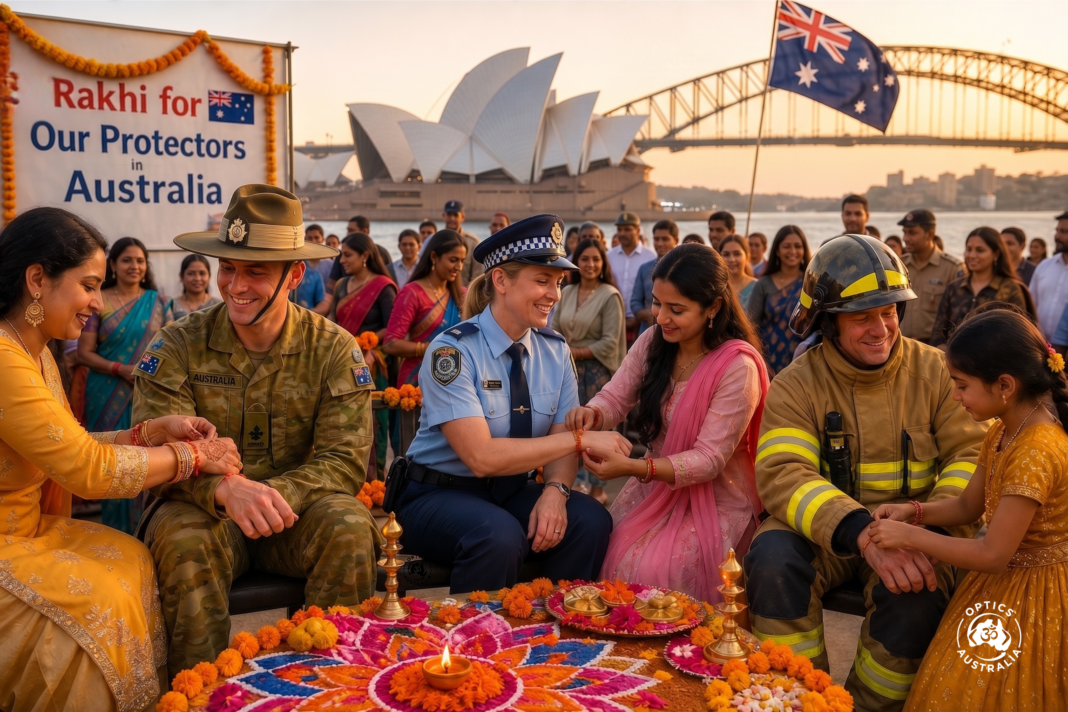
Many organisations also invite personnel from or visit police stations, fire brigade, ambulance stations, etc. and tie rakhis to express gratitude and solidarity with those who serve the people and protect the community.
Building Community Through Togetherness
Hindu temples, associations and community organisations can transform individual family celebrations into opportunities for wider connection. The Hindu Organisations, Temples and Associations (HOTA) Forum in Victoria, for example, celebrated Raksha Bandhan at Shri Shiva Vishnu Temple Carrum Downs on 8 August 2026 and has brought Hindu organisations together through its activities and annual celebrations since 2014.
Across Australia, temples and organisations can collaborate, share resources, welcome newcomers and provide belonging to people living far from extended family. This can be particularly valuable for students, young professionals, newly arrived families and older people who may otherwise experience social isolation.
The idea of rakṣā can also inspire practical service, including visiting isolated community members, supporting charities, organising blood-donation initiatives, volunteering, welcoming newly arrived families, supporting people experiencing hardship, promoting respectful relationships and inviting neighbouring communities to participate.
In this way, the symbolism of the rakhi becomes an ethic of care and service.
Nurturing the Next Generation
For Hindu children growing up in Australia, Raksha Bandhan offers a joyful connection between family life and cultural heritage. Children can learn to tie a rakhi, participate in prayers, hear traditional stories and understand the values behind the rituals.
Young people can reflect on how they show care for siblings and friends, their responsibilities towards elders and younger children, how they can welcome newcomers, and how cultural values can be translated into community service.
Such conversations help young people inherit the spirit of Raksha Bandhan rather than simply its outward customs, while demonstrating how Hindu traditions can contribute positively to Australia’s multicultural civic life.
Connecting Generations Across Distance
Hindu families across Brisbane, Sydney, Melbourne, Adelaide, Perth, Canberra and regional communities often maintain relationships with relatives in India and elsewhere. Raksha Bandhan provides a meaningful way to sustain these connections.
Some families will gather around the dining table; others will celebrate at temples or community centres. Relatives unable to travel can join through video calls. For those without relatives nearby, community organisations can provide a shared space of belonging.
An inclusive celebration should reflect hospitality, respect, generosity and care. Children can make rakhis, young people can organise activities and volunteer, elders can share stories, and newly arrived families can be welcomed. Accessibility should also be considered so that older people and people with disabilities can participate comfortably.
Raksha Bandhan 2026: A Thread That Connects Us
Raksha Bandhan 2026 falls on Friday, 28 August in Australia. The precise auspicious timing may vary according to location, pañcāṅga tradition and individual temple or family practice, so families should confirm the appropriate timing locally.
The rakhi is a small thread, but its symbolism is profound. It represents a bond between two people while reminding us of the responsibilities that accompany relationships. It encourages us to value our families, care for elders, nurture children, support friends and contribute to the wellbeing of our communities.
The traditions of Yama and Yami, Yama and Yamuna, the Raksha Bandhan mantra and Sarve Bhavantu Sukhinah together offer a powerful message: affection becomes meaningful when accompanied by responsibility, and communities become stronger when care extends beyond ourselves.
As Hindu families, temples and organisations gather across Australia, the sacred thread can become a symbol of belonging, compassion, mutual respect, service and social harmony.
May Raksha Bandhan 2026 bring peace, affection and renewed solidarity to Hindu families and communities throughout Australia. May the sacred thread inspire us to strengthen our relationships, care for one another, uphold dignity and contribute to the wellbeing of the wider Australian community.
Happy Raksha Bandhan 2026!