


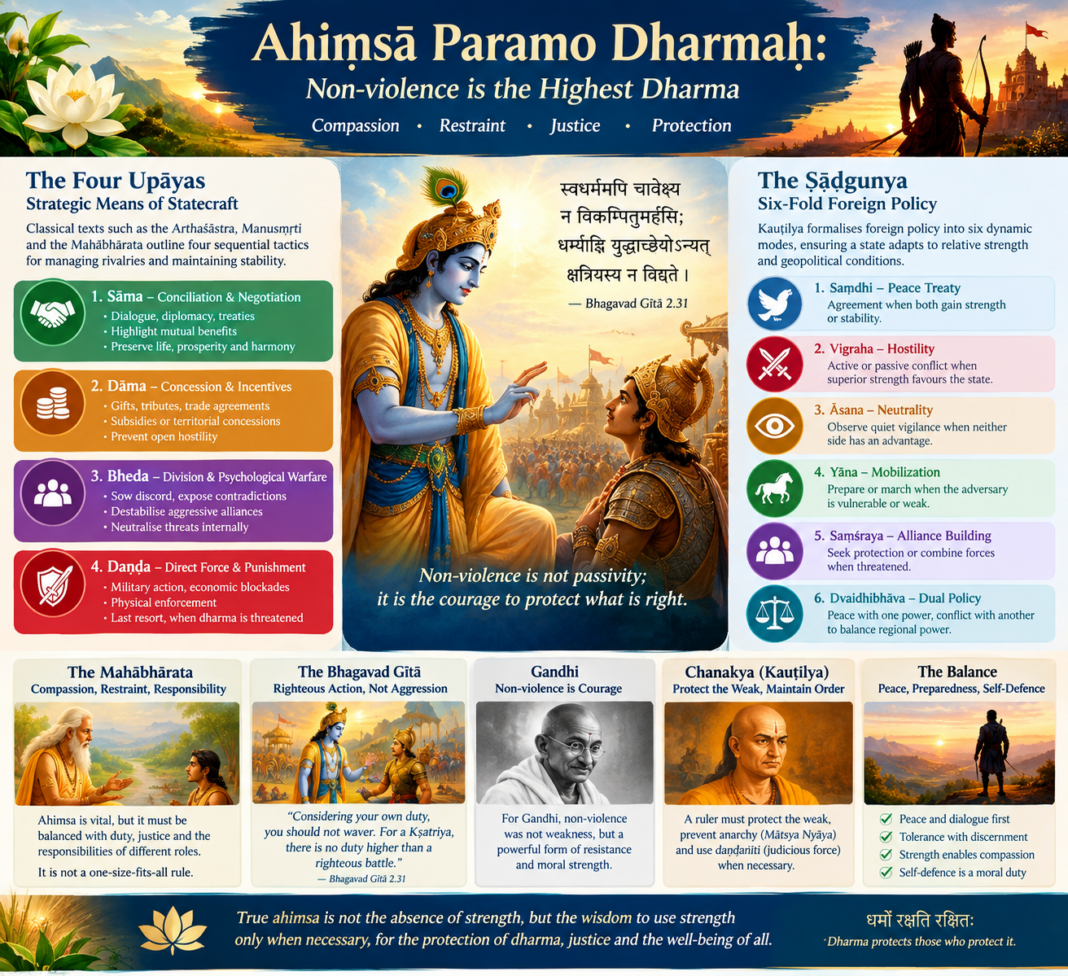
अहिंसा परमो धर्मः
What Hindu philosophy, the Mahābhārata, the Bhagavad Gītā, Cāṇakya and Gandhi, teach us about non-violence and self-defence.
Is non-violence a sign of strength or weakness?
The principle of Ahimsā Paramo Dharmaḥ (अहिंसा परमो धर्मः), commonly translated as “non-violence is the highest dharma”, is one of the most widely quoted ethical expressions associated with Hindu traditions. Yet its meaning becomes narrower when detached from the wider discussion of dharma, responsibility and context.
The Mahābhārata (महाभारत) repeatedly explores situations in which duties conflict.
One such example is in Ādi Parva (आदि पर्व) with the story of Ruru and the serpent. Ruru’s beloved Pramadvarā died from a serpent bite but was restored to life. Consumed by anger, Ruru began killing serpents indiscriminately. When a serpent (actually a cursed sage) challenged him, he realised his revenge had become unjust. The moral is powerful: grief may explain our anger, but it never justifies injustice; true strength lies in mastering vengeance with compassion and wisdom.
The epic therefore does not reduce ethical action to a universal command that every person must respond to every threat in the same way.
The popular expression Dharma hiṃsā tathaiva ca (धर्म हिंसा तथैव च) is sometimes appended to the ahimsā maxim, but this is not securely established as the original continuation of the verse. The underlying issue, when force may be justified, is nevertheless a recurring concern in the epic. The important lesson is that ahimsā should not be separated from the wider discussion of dharma, responsibility and justice.
Bhagavad Gītā: duty, action and moral restraint
The Bhagavad Gītā (भगवद् गीता) presents one of the most important discussions of the tension between compassion and the duty to act.
Arjuna (अर्जुन) is distressed at the prospect of fighting relatives, teachers and friends. Kṛṣṇa (कृष्ण) does not simply dismiss his distress; instead, he asks Arjuna to examine his responsibilities, the nature of the conflict and the principles governing action.
In the Bhagavad Gītā 2.31 Kṛṣṇa states that, considering his own duty, Arjuna should not waver, and that for a Kṣatriya (क्षत्रिय) there is no duty higher than righteous battle. The passage is situated within the specific circumstances of the Kurukṣetra war and therefore should not be transformed into a general licence for aggression.
The broader teaching emphasises self-control, freedom from attachment to personal reward and action consistent with dharma. The ethical distinction is therefore between violence driven by hatred, revenge or personal gain and difficult action undertaken from a sense of responsibility.
स्वधर्ममपि चावेक्ष्य न विकम्पितुमर्हसि ।
धर्म्याद्धि युद्धाच्छ्रेयोऽन्यत् क्षत्रियस्य न विद्यते ॥
Svadharmam api cā vekṣya na vikampitum arhasi;
dharmyād-dhi yuddhāc-chreyo’nyat kṣatriyasya na vidyate.
Considering your own duty, you should not waver;
for a Kṣatriya, there is no duty higher than a righteous battle.
Protecting the weak and maintaining order
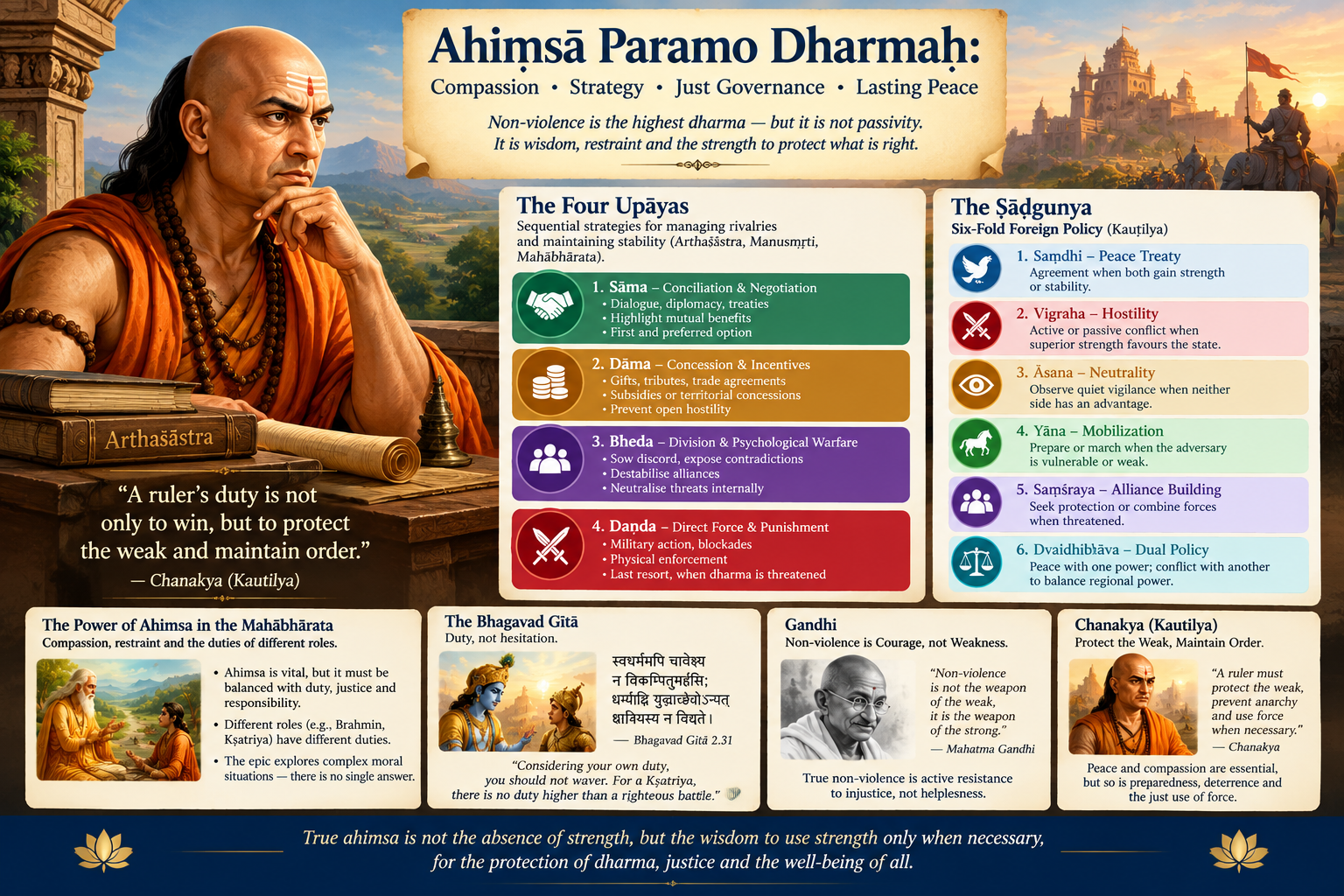
Kauṭilya (कौटिल्य), also known as Cāṇakya (चाणक्य), approaches the question from the perspective of governance. The Arthaśāstra (अर्थशास्त्र) treats the protection of people, maintenance of order and preservation of the state as central responsibilities of rulership.
Mātsya Nyāya (मात्स्य न्याय) — the law of the fishes
Mātsya Nyāya describes a condition in which, without effective authority, the strong can exploit the weak—like larger fish consuming smaller fish. The concept provides a political rationale for legitimate authority: governance is needed not merely to exercise power, but to prevent the vulnerable from being dominated by the powerful.
Daṇḍanīti (दण्डनीति) — disciplined authority
Daṇḍanīti concerns the principles governing punishment and authority. The supplied material emphasises proportionality: excessive punishment generates resentment, while inadequate enforcement can encourage disregard for law. Effective authority therefore requires judgement rather than arbitrary violence.
This framework also recognises strategic restraint. A ruler should not enter a battle merely to display courage if doing so would needlessly endanger the kingdom. Peace, alliances, withdrawal and other strategic options may be preferable. Cāṇakya’s statecraft consequently combines capacity for force with the judgement to know when force should not be used.
Diplomacy before destruction
Ancient Indian political philosophy presents a remarkably layered approach to conflict, sovereignty and international relations. In the classical statecraft tradition, the objective is not simply to win a confrontation, but to preserve order, protect the vulnerable, secure the interests of the state and avoid unnecessary destruction.
This approach is especially visible in the Four Upāyas (उपयाः) – Sāma (साम), Dāma (दाम), Bheda (भेद) and Daṇḍa (दन्ड), and in Kauṭilya’s Ṣāḍguṇya (षड्गुण्य), the six strategic modes of foreign policy. Read alongside Mahābhārata, Bhagavad Gītā and the wider Hindu understanding of dharma, these ideas suggest that peace and preparedness are not necessarily opposites.
The underlying principle is one of graduated response: begin with peaceful means; use incentives and strategic measures where appropriate; and reserve coercive force when other avenues have failed or when protection of people and political order requires it.
The Four Upāyas: a graduated strategy
The classical tradition identifies four broad means by which a ruler or political community may address rivalry, conflict and threats. They are better understood as a repertoire of strategic instruments than as a rigid mechanical sequence. Their appropriate use depends on circumstances, the character of the adversary, the interests at stake and the possibility of preserving peace.
| Upāya | Core approach | Strategic purpose |
| Sāma | Conciliation, dialogue, persuasion and negotiation | Resolve disputes peacefully and identify mutually acceptable outcomes. |
| Dāma | Material incentives, concessions, gifts, agreements or inducements | Address an opponent’s material interests and reduce incentives for conflict. |
| Bheda | Strategic differentiation, intelligence and exploitation of divisions | Reduce the capacity of a hostile coalition or expose internal contradictions. |
| Daṇḍa | Coercive enforcement, punishment or military force | Protect people and political order when peaceful or strategic measures are insufficient. |
1. Sāma — conciliation and negotiation
Sāma places communication at the centre of conflict management: dialogue, persuasion, diplomacy, treaties and appeals to shared interests. Its importance reflects a fundamental preference for resolving disputes without unnecessary loss of life, wealth or social stability.
In modern terms, Sāma can be understood through negotiation, confidence-building measures, diplomatic engagement and agreements designed to create mutual benefit.
2. Dāma — incentives and concessions
When persuasion alone is insufficient, Dāma introduces material or political incentives. These may include gifts, trade arrangements, concessions, tribute or other measures that address an opponent’s interests and create reasons to avoid confrontation.
The principle is pragmatic: durable peace may sometimes require accommodating legitimate interests without surrendering essential security or sovereignty.
3. Bheda — strategic differentiation
Bheda concerns the use of intelligence, strategic differentiation and awareness of divisions within an opposing political structure. In a contemporary reading, this can include diplomacy aimed at separating an adversary’s interests from those of its allies, exposing conflicting objectives or preventing hostile coalitions from consolidating.
This is the most ethically sensitive of the four means because strategic manipulation can itself create instability. Its classical context is therefore best understood within the broader responsibilities of the ruler and the objective of protecting the state.
4. Daṇḍa — force and enforcement
Daṇḍa represents coercive authority: punishment, enforcement and, where necessary, military action. It is not presented as an invitation to aggression. Rather, the broader statecraft tradition treats force as one instrument of governance whose legitimacy depends on necessity, proportionality, judgement and the protection of political and social order.
The strategic significance of Daṇḍa lies partly in its existence as a credible capacity. A state that has no ability to enforce its laws or defend its people may be unable to deter those who are willing to exploit weakness.
Non-violence as courage, not helplessness
Mahatma Gandhi developed ahimsā into a method of political resistance. His interpretation differed in important respects from a conventional statecraft doctrine: he placed non-violent resistance at the centre of political action and accepted suffering rather than retaliatory violence as a moral discipline.
At the same time, Gandhi rejected the idea that non-violence should be equated with cowardice or helpless submission. In a 1920 discussion published in Young India, he argued that where the only choice appeared to be between cowardice and violence, he would advise violence, while maintaining that non-violence was superior. His broader point was that genuine non-violence requires courage and strength rather than fear.
This provides an important bridge to the wider discussion: choosing restraint can be an expression of strength when it is deliberate and principled, rather than simply the consequence of an inability to resist.
From tolerance to responsible restraint
The most useful synthesis is not a simple opposition between tolerance and force. Ethical restraint and strategic preparedness can coexist. A society may value peace while retaining the capacity to defend its people; an individual may practise forgiveness without accepting exploitation; and a state may prefer diplomacy while maintaining credible means of enforcement.
Modern discussions of tolerance similarly raise a question about the limits of tolerance when actors reject reciprocal coexistence. The important distinction is between tolerating disagreement and permitting coercion, violence or systematic domination to proceed without response. Openness requires protection of the conditions that make openness possible.
This does not mean that every adversary should be treated as an existential threat, nor that force is automatically justified. It means that tolerance itself requires judgement about context, reciprocity, proportionality and consequences.
A unified model for Hindus today
Together, these traditions suggest a strategic ethic with several connected layers:
- Prefer peaceful resolution where a durable settlement is possible.
- Use incentives and negotiated interests to reduce the causes of conflict.
- Employ intelligence and strategic differentiation when hostile coalitions threaten security.
- Maintain alliances, neutrality or strategic patience when circumstances make them more effective than confrontation.
- Preserve the capacity for lawful enforcement and defence so that vulnerable people are not left without protection.
- Use force only with serious attention to necessity, proportionality, responsibility and consequences.
- Distinguish courage and responsibility from anger, revenge, domination or aggression.
Diplomacy, incentives, alliances, strategic patience, deterrence and defensive capability can form parts of the same policy architecture.
There is also a caution against two opposite errors. The first is interpreting ahimsā as unconditional passivity, thereby confusing compassion with helplessness. The second is invoking dharma as a blanket justification for violence, thereby confusing responsibility with aggression. A more careful interpretation places both peace and protection within a framework of dharma.
The central question becomes not simply whether an action is forceful or non-forceful, but why it is undertaken, what alternatives exist, whom it protects, whether it is proportionate, and what consequences it is likely to produce.
|
Peace is not helplessness. Compassion is not cowardice. Courage is not aggression. |
References and further reading
- The Mahābhārata, Ādi Parva, including the story of Ruru and the serpent.
- Bhagavad Gītā, Chapter 2, verse 31.
- Gandhi, M. K. (1920). “The Doctrine of the Sword” / discussion of non-violence and cowardice, Young India, 11 August 1920.
- Gandhi, M. K. My Non-violence, Chapter 113, “A Woman’s Dilemma.”
- Kauṭilya. Arthaśāstra, Book 1, Chapter 4, “The End of Sciences.” Translation by R. Shamasastry.
- Manusmṛti, passages concerning governance, punishment and duties of rulers.
- Kauṭilya’s Ṣāḍguṇya framework of foreign policy and the Four Upāyas of classical Indian statecraft.